ISSUE NO. 68, February, 1989
Scanned, OCR'ed, and proofed by Bob "Bacon" Bruhns WA3WDR
Major Parts Sources To Dry Up?
AMers and other homebrewers, as well as non-radio hobbyists, craftsmen, small business entrepreneurs, and others whose operations depend on the availability of specialty items, now face a new threat from proposed government legislation. No, this is not a story about the latest FCC docket or yet another local zoning ordinance trying to legislate us out of existence, but an ongoing effort by state governments to enact federal legislation which would ultimately cause most mail-order sources of parts and equipment to dry up. Since your nearest Radio Shack is unlikely to carry much in way of tubes and transmitter parts, and there is probably no electronics surplus store at the local shopping mall, the primary remaining sources of this material, as well as all other specialty items (photographic, automotive, scientific, etc.), are the mail order outlets. When these sources are gone, there will only remain flea markets, swapfests and auctions - individuals trading among themselves - until existing supplies of material remaining in the hands of individuals are exhausted.
Mail order business is being threatened by federal legislation that would require catalogue firms to charge state sales taxes and forward that revenue back to the home state of each mail order customer. Unlike retail merchants which now must, at considerable expense and man-hours of paperwork, serve the function of tax collector for their home states, mail order firms would be forced to multiply all this bureaucratic red tape and paperwork by fifty, and simultaneously serve as tax collectors for every state in the union (except possibly for one or two states which still have no sales tax). It doesn't take tremendous intelligence or foresight to figure out what will happen if this legislation is allowed to pass. Many small parts suppliers and surplus equipment dealers are nothing more then "cottage industries," run by individuals out of their basements and garages, marginal operations at best. This additional tax collecting burden will simply force them out of business. The few remaining mail order outlets will pass the additional overhead expense on to the customer, resulting in higher prices for all goods, plus tax. And these will be large nation-wide "amateur radio supply houses" geared towards mainstream amateur radio, with all the new Yaesus and Kenwoods one could desire. The businesses to go under as a result of the proposed tax burden will be the small "Junkbox" suppliers which still offer vacuum tubes and the kinds of goodies sought by AMers and other homebrew artists.
The root of the problem is fiscal irresponsibility of government at all levels. After local, state and federal governments had overextended themselves for years, politicians at all levels began to recognize that the time is fast approaching to pay the piper. With election year pledges not to further "raise taxes" in the minds of voters, the federal government ended "revenue sharing" (free gifts of federal money to local governments), and cut many social programs for which the slack must now be taken up at the state and local levels. Financially strapped state and local governments are simultaneously feeling the squeeze from above and below and from all sides, and bureaucrats are single-mindedly grappling for revenue sources anywhere they think they might squeeze out a few more bucks without having to go on record as openly boosting existing tax rates. Recently, attention has been focused on mail order firms which ordinarily do not charge sales tax on out-of-state orders.
If mail order goods must be taxed, it would be far simpler to collect sales tax for the home state on all orders, regardless of where the customer lives. The catch to that approach is that the U.S. Supreme Court has already ruled it unconstitutional to charge local sales tax on out-of-state orders, but laws requiring mail order firms to collect and return taxes to the customer's home state are untried in the courts.
Anticipating passage of the federal legislation, Tennessee and several other states have already enacted state laws requiring residents who buy from out-of-state catalogue companies to pay sales tax to the home state, effective January 1, 1989. But the states are powerless to force out-of-state companies to collect taxes for them. State Senator Leonard Dunavant, who sponsored the Tennessee state law, remarked that lawmakers have done all they can and now need help from the U.S. Congress. "We'll just try to force our way in on it." Dunavant was quoted as saying. U.S. Representative Bart Gordon of Murphreesboro, TN, cosponsored the federal catalogue bill last year, but the measure never passed. Tennessee's U.S. congressional delegates will be lobbied to push for the federal legislation again. Similarly, other states have promised to simultaneously push to get the federal legislation passed.
Proponents of this federal legislation argue that their states are losing tens of millions of dollars annually in uncollected sales tax on out-of-state mail order goods. "It is not treating the business places in (the home state) fairly," they grumble. But compared to any state's total revenue, mail order losses are a drop in the bucket at most. Recovery of this loss does not justify the destruction of the mail order industry, which despite a few "bad apples" (see elsewhere in this issue), has served legitimate needs of the American public for over a century. If tax legislation forces the end of most catalogue sales, neither the states nor local firms will enjoy much additional revenue anyway. The claim of "unfairness" to local business firms is bogus. How many "local" retailers stock the kinds of specialty items sold by Fair Radio, L.L. Bean, J.C. Whitney and Antique Electronics Supply? If Fair Radio is forced out of the mail order business, AMers are not going to be putting more money into the local economy by purchasing modulation transformers and T-368's from K-Mart.
Very few consumers go to the trouble to mail order goods available at comparable prices at local retailers simply to get out of paying sales tax. Mail order is a considerable hassle already, involving filling in order blanks, supplying correct catalogue stock numbers, estimating shipping charges, satisfying minimum order requirements, and waiting sometimes for weeks for goods to arrive, at a substantial risk of shipping damage. In most cases, any money the customer saves on sales tax is more than absorbed by "handling fees" and shipping costs. (Have you tried shipping anything by parcel post or UPS lately?) The people most likely to order locally available retail items by mail are those who need this service to survive - the elderly and infirm who are physically unable to get out to the local shopping mall or discount warehouse.
Incidentally, the proponents of this federal legislation do not appear to be totally oblivious to the devastating effect it would have on mail order sales. A lawmaker from Kentucky was recently quoted in the newspaper as saying he thought the proposed legislation was doubly in the public interest because it would "reduce the volume of junk mail we receive by 90 percent." These lawmakers are knowingly willing to close down catalogue sales.
We must let our representatives in the Senate and Congress know our feelings on this issue. Remember, the legislation could pass without open debate; many of to-day's federal laws are enacted in an under-the-table manner, in the form of a sub-paragraph attached to some more prominent bill before Congress, which is totally unrelated to the subject legislation.
If you believe it to be in the public interest to maintain the availability of goods by mail order, it is strongly suggested that you take the time to look up the addresses of your representatives in the U.S. Congress and Senate, your state legislators, and the newly-elected read-my-lips-no-new-taxes President of the United States. Put your thoughts in writing, run off some photocopies, and drop each of them a line expressing your opposition to this proposed legislation. Be sure to rationally explain why you oppose a measure that promises to bring more revenue to your home state without creating "new" taxes or raising existing rates. Talk over this issue with others, on the air and in person. We must not allow the mail order industry to be killed by the single-minded ob$e$$ions of a few short-sighted politician$.
If you feel strongly on this issue, be sure to write a letter to the editor of your local newspaper. If every amateur radio operator who occasionally uses mail order service would get one letter printed in a local newspaper, millions of citizens nationwide, who otherwise would not bother to think this issue through, would be exposed to the opposing viewpoint.
Robert Stankus Update
Long-time AMers will recall RM-3665, a petition submitted to the FCC an April 15, 1980, by Robert W. Stankus, N1AAR, which sought to amend the amateur rules to eliminate the use of AM as a means of voice communication on all amateur bands. This petition contained the standard anti-AM tirade about technical progress and bandwidth, and in addition, argued that AM should be eliminated because "manufacturers no longer build equipment capable of delivering ...and receiving AM signals"!
Interestingly, the callsign N1AAR first became familiar to AMers prior to RM-3665 through the old Press Exchange, published by W2NRM in New Jersey, and predecessor to The AM Press/Exchange. Stankus ran display advertisements in issues number 2, 4 and 5 (1980) offering to sell vacuum tubes. Soon after its conception, Press Exchange began to run stories about rumours of petitions and another FCC action to ban AM from the amateur bands. Issue no. 3 printed "the following news from N1AAR. Did you know that there is presently before the FCC a petition for rulemaking calling for a maximum of 3.75 khz of space (sic) to be allotted to a phone signal. If that is passed and there is every likelihood it will, AM is dead, because there is no way that spec can be met. What we should be doing is fostering new and improved methods of voice communications. One that comes to mind is "Pulse Code Modulation". They are now making LP music records and the results are outstanding. No noise! Imagine that and all with just about zero bandwidth. Read up on this. It's the next major breakthrough in Ham Radio." This news item failed to mention that N1AAR was the originator of the petition.
Issue no. 4 published news of "proposed rulemaking #20889. ...Nestled in amongst the fine text is a paragraph calling for severe limitations on bandwidth as applied to voice communication (maximum 3.75 khz) ...this NPRM ...was originally filed in 1977 ...Portions of this news report supplied thru the courtesy of N1AAR..." Meanwhile, the N1AAR tube ads continued to run in Press Exchange.
Issue no. 6 continued to report on this story. An article titled "AM Under Fire" mentions "RM 20889", "another new bandwidth proposal", and "still another petition for the elimination of AM, filed April 15, 1980", continuing with verbatim excerpts from the text of RM-3665. Still no mention was made that Stankus was the author of the April 15 petition. However, the N1AAR tube ad no longer appeared in issue no. 6 or any subsequent issue. Issue no. 6 also printed a letter from WB4AIO who had checked with the FCC in Washington. Kevin reported that Docket 20889 existed but had nothing at all to do with amateur radio. He did report that a new bandwidth proposal was to be released in "June or July" (1980). In November, 1980, FCC released the infamous and ill-fated "Plain Language Rewrite." Nestled in the text was indeed a proposal calling for a maximum bandwidth of 7.0 khz for A3 emission (both AM and SSB).
Issue no. 7 of Press Exchange finally disclosed the full story on RM-3665, including the fact that it filed by N1AAR, based on information "received on May 29, 1980."
RM-3665 continued to be a topic of lively discussion in AM circles until news was received that on February 26, 1981, RM-3665 had been summarily dismissed by the FCC as having no merit. The Commission reported that it received 83 comments in this proceeding, in which only one comment supported the petition. Prompt action by the AM community nipped that one in the bud!
Ironically, in every likelihood, the ultimate result of Robert Stankus' petition was to strengthen the AM cause, by forcing the FCC to put on the official record that the continued use of AM in amateur radio is in the public interest. Also, this petition united the AM community, and provided the fledgeling Press Exchange with a ready-made crusade, allowing it to gain enough momentum to establish itself within the growing community of amateurs returning to AM phone. Events soon followed which clearly demonstrated the value of an amateur radio publication dedicated to AM. S.P.A.M. was to soon be reorganized to become much more effective in its endeavour to re-establish AM as an accepted facet of amateur radio. Press Exchange continued monthly publication for 36 issues until it ceased operations in December, 1982 due to the retirement of W2NRM and his decision to move to Florida.
Precisely when the AM community was suddenly and unexpectedly left without a publication, the FCC released Docket 82-624, the p.e.p. output proposal. Donald Chester, K4KYV, editor and publisher of The AM Press/Exchange, hurriedly threw together a packet of information on this ominous piece of legislation, obtained W2NRM's Press Exchange mailing list, and sent several hundred AMers full details on the docket and suggested effective action that could be taken to oppose the FCC's scheme to reduce the AM power limit.
The overwhelming response Don received from the AM community convinced him of the continuing need for some kind of AM publication, and thus The AM Press Exchange was born. The first issue arrived in the mail just five months after the demise of the original Press Exchange, using largely the same format. For the second time, a blow aimed against the AM community resulted in the establishment of an AM publication, and AM enthusiasts remained determined to keep their favorite mode a legitimate part of amateur radio.
Perhaps indulging in a little vindictiveness after the RM-3665 ordeal, many AMers openly expressed delight when the August, 1981 issue of Ham Radio magazine (on page 6) reported that Robert Stankus, N1AAR, operating a mail-order firm called Keswick Sales, had been indicted on 22 counts of using the U.S. mails to defraud, by a Federal grand jury in Roanoke, VA on June 10, 1981. Stankus had allegedly advertised new Kenwood TS-520SE's in the Ham Trader Yellow Sheets for the bargain price of $369.95 each. Eventually, more than 50 amateurs filed complaints with the Postal Service over his failure to deliver the rigs they had ordered through his ads. It was reported that Stankus actually did deliver a couple of transceivers, which he had purchased from legitimate dealers at near list prices.
At his first appearance before the judge on July 6, 1981, Stankus pleaded not guilty to all 22 counts. Facing a maximum fine of $1000 and five years in prison for each count, he decided to change his plea to guilty on 11 of the counts in return for having the 11 other charges dropped, according to a follow-up report published on page 10 of the November, 1981 issue of Ham Radio. It was not reported what sentence, if any, Stankus ultimately received for his part in the mail-order sales scheme. Justifiably or not, many AMers felt vindicated. This news story proved them right all along; the anti-AMer was publicly exposed as a villain while the AMers remained the "good guys".
epilogue
Recently, the name Robert Stankus appeared again in the amateur radio press. The January 20, 1989 issue of Westlink Report carries a news item on page 5, concerning experimental operation on 17 metres. The report, written by Fred Sontag, N0CAO, describes a group of amateurs with experimental licenses from the FCC, who are exploring the band with regular "skeds" on Saturday and Sunday at 1900 GMT on 18.111 mhz. According to the report the regular participants are Bill Orr, W6SAI (KM2XDW) in California; Stu Cowan, W2LX (KM2XDU) in New Hampshire; and N0CAO (KA2XAE) in Missouri, with occasional participation by Phil Galasso, K2PG (KA2XUK) in New Jersey, and ROBERT STANKUS, WS4I (KB2XCQ) in Virginia. For 17 metre operation, the experimental callsigns, indicated in parentheses, are used instead of regular amateur callsigns.
A "vanity" listing in the 1989 North American Callbook reveals the Richmond, VA address of Robert Stankus, WS4I. EDITOR'S NOTE: Out of fairness, our readers are reminded that, assuming Robert Stankus, WS4I, is indeed the same individual as N1AAR, there is nothing in this article or the quoted news reports to imply any impropriety in Mr. Stankus' present-day activities.
1989 WINTERFEST tm
Virginia (Vienna)--February 26, 1989.
Sponsor: Vienna Wireless Society 1989 Winterfest.
Time: Tailgate/Seller setup begins 6 AM, General Public 7:30 AM.
Place: Vienna Community Center 120 Cherry Street, Vienna, Virginia (off Route 123).
Features: Newly enlarged indoor exhibition area. Breakfast and lunch available.
Talk-in: K4HTA/R 146.085/146.685 or W4LBL/R 146.190/146.790.
Admission: $4.00 door, $7.00 tailgate, $10.00 (non commercial) and $15.00 (commerical) for indoor tables. (No advance door and/or tailgate sales.)
West Coast Report
by W6RNC
A/M activity for the fall and winter season has been down compared to last year, except for 10 meters. The 10 meter activity seems to have lured away almost all the 1885 kc. activity. 160 has been almost a ghost town this season, except for such stalwarts as NI6S, WD6EWE, W6RBZ and a couple of others.
The West Coast SPAM Wednesday night 9PM 3870 kc. schedule has been going very well, usually lasting for 3 hours with 10 or more check-ins. New SPAM A/M stations show up here from time to time. It seems that Oregon has produced the most newcomers lately, with KL7GKY/7 and K7CL (ex KL7CL) the most recent. Washington is doing very well, Idaho and Colorado are in from time to time. California seems to be in the doldrums--especially northern California.
The SPAM Sunday 4PM 7156 kc schedule is holding its own with 5 or 6 regulars. Attention East Coast and Central SPAM members! Many non-SPAM members have appeared on 10 meter A/M with the advent of good band conditions. It would be helpful, when you are qso-ing with these W6 stations, if you would please let them know of the West Coast A/M activity on other bands, where they would be very welcome to check in.
Murphy Strikes AM P/X (again ... and again)
After the December/January issue was sent to the printer, with the explanation of the expected delay in publication, Murphy struck again and five additional days of delay were added. We ran out of the special staples used in the saddle stapler which fastens each copy together. No office supply store in town keeps these in stock, so more were ordered while publication was put on hold. We were promised delivery within two days, but three days later when the staples arrived they were the wrong size. They were re-ordered, with delivery promised the next day. We checked the next day; the package was "left off the truck by mistake." A phone call assured us that the staples would arrive the following day. Once again the box "was not loaded on the truck." Issue no. 67 had been lying around for nearly a week now, waiting for staples. So we decided to mail the remaining copies without staples rather than delay publication any further. About 25 percent of our subscribers were affected. If your AM P/X arrived without staples last month, rest assured that this and all subsequent issues will be stapled together as usual. By the way, as you might have guessed, the new supply of staples arrived the same day the stapleless copies were assembled and mailed out.
Everything was on track this month, and we had anticipated getting the February issue out on schedule, but The AM Press/Exchange continues to be plagued by Murphy's Law. Don Chester, editor and publisher, learned that his son has a serious bone infection which will require several weeks of treatment. This is the same child who was attacked by loose dogs in October, 1987. Doctors do not believe his present condition is related to injuries resulting from the dog attack. Don in now trying to care for the 2-1/2 year old daughter while his wife is occupied with their son, still maintaining the schedule of teaching at two different schools. Once again this month, AM P/X is sitting unattended, and as of this writing, Don has no idea when this issue will eventually be delivered.
How Do We Spell Relief? Q-S-Y
WB2KPH
The following information concerning the packet radio signal on 29.050 mhz was received by Mike, WB2KPH, on his local packet BBS. The signal has been causing considerable disruption to AM operators using the 29.0 - 29.2 mhz "AM Window".
(Message received on January 10, 1989.)
[5945] BF BID: 41441_N4QQ
Paths WB3DNQ!WA3ZNW!N4QQ
Date: 10 Jan 88 03:36:16 E
From: K3AKK@N4QQ
To: ALL@MDCBBS
Subject: NATCAP 29.050 Node off the air
The K3AF-7 / NATCAP node on 29.050 has been temporarily removed from service pending a decision at FCC on the necessity for and/or desirability of issuing a Special Temporary Authorization for its operation at 1200 baud packet on FM AFSK at that frequency in the 10 meter band. It was determined that there appears to be no specific FCC Part 97 authorization for that mode of operation on 10 meters. The node had been providing 6 hour a day connectivity to the AZSE node and the 145.01 network in Arizona. Informed opinions are welcome.
73, Dick - K3AKK @ N4QQ, sysop DCA nodes
DE WB3DNQ BBS (B,D,H,I,J,K,L,N,R,S,T,U,V,W,X,Y,?) )
(Update received on January 13, 1989.)
[6036] BF BID: 41736_N4QQ
Path: WB3DNQ!WA3ZNW!N4QQ
Date: 13 Jan 88 00:26:46 E
From: K3AKK@N4QQ
To: ALL@MDCBBS
Subject: More: NATCAP Node Changes
Two days ago, the NATCAP node which operates on 29.050 1200 baud FM and the connecting node, AZSE in Arizona was taken off the air when it was determined that there was no specific authorization for FM AFSK packet on ten meters. I have since been advised that it WAS the intent of the FCC to not authorize this mode while, at the same time, authorizing other wide band modes such as FM voice and AM on ten meters. This is understandable, as there were many active voice stations at the time the regulations were drawn and few packet stations. While a Special Temporary Authorization might be requested, I was advised by Paul Rinaldo at ARRL that ARRL probably would not support the STA when the FCC asked for its comments. This position could be changed by action of the ARRL Board. It would require action on the part of packet operators to make their desires known to their Division Directors. While there is a Board meeting this coming week, I would not think that any action might be taken on this situation, as it is not on the agenda for the meeting. I would guess that we would be on the downside of the current solar cycle before there would be a favorable decision.
So,..... the NATCAP and AZSE modes will be moving to 28.205, 1200 baud, FSK. Tests run today indicate that this circuit does reflect the calculated 6 dB advantage over the old FM circuit. When NATCAP reappears in the node tables next week, it will be on the new frequency and connecting to AZSE in Arizona and COLO10 in Colorado Springs, CO. Both distant nodes access their 145.01 networks. The WASHDC node will remain on 28.105, 300 baud, FSK. Both nodes will be at the Silver Hill site with 300 feet vertical separation between antennas and cross polarization providing protection from receiver desense. The WASHDC node uses an ICOM 730 and the NATCAP node a Drake TR-7. The WASHDC node uses an AEA PM-1 HF adapter & TNC-200 and the NATCAP node uses a TNC-200 modified for variable threshold DCD and true tone data carrier detect. A ten meter bandpass cavity filter, if one could be found, might improve the operation.
In summary, NATCAP will return to the air in a few days connecting not only to AZSE but also to COLO10. The packets will flow much faster on the new circuit. This circuit is on 28.205, 1200 baud. (The dial frequency is 28.205 and the mode is lower sideband using standard 1200/2200 tones.)
Dick - K3AKK @ N4QQ
DE WB3DNQ BBS (B,D,H,I,J,K,L,N,R,S,T,U,V,W,X,Y?) )
THE REAL VOICE OF AMERICA * AMATEUR RADIO
Dear Editor: The 75 meter AM Thanksgiving Homecoming Jamboree on Friday and Saturday after Thanksgiving was very pleasant, even though we neglected to talk it up the weeks before. Maybe next year I shall remember to insert a notice in your Thanksgiving issue.
With ten meters opening up, we are receiving calls on 28.706 from old neighbors on AM who have moved to Fla., Texas, Arizona, Colo., Ore., Wash., etc. Forty years ago when ten meters was much busier than today (my dad had 235 10 meter mobilers on his transmitter hunt list in north Jersey) our primary operating frequency was 28.706 and our secondary AM mobile frequency was 29.400. Today I suggest 28.7 to 28.71 as a good primary AM frequency. For many decades I have monitored 28.706 continually.
Of late while on ten meters I often call "CQ freedom of speech" and I am happy to report that several Europeans did respond, even though their governments do not protect and preserve their God-given privilege to speak freely. I am sorry to report that I have not had a free provocative conversation with any of the many Russians who call me, and Mr. Gorbachev never responded to my July letter concerning individual radio broadcasting between we-the-people in Russia and America.
73 & 76, Irb, W2VJZ, Liberty Or!, NJ 07938
MAKING AM THE GREAT NEW GUY ON THE BLOCK
or HOW YOU CAN GREATLY OVERCOME POWER LIMITATIONS ON AM
Copyrighted, 1989, by George A. H. Bonadio, W2WLR
Watertown, NY 13601-3829Part 4
To Understand Radio, We Understand Decibels
Isn't it interesting! In every important text in radio there are anywhere from one to six pages of tables explaining decibels, dB. Oh, but not in some amateur text, which survives from advertisers who are selling very expensive decibels of radio gear, will you see any tables of dB.
Yes, comparing decibels and dollars, dB and $ is what this is all about. Efficiency is rated in dB and cost is rated in $. We now need a "feel for dB" just as we have learned to "feel for $". It is easy. It's something like riding a bicycle. Once you learn to go with it, it's the easiest way to go.
First, dB's are shortcuts for us who do not like to multiply or to divide more than one digit at a time. The dB way is to add dB in place of multiplying, and to subtract dB in place of dividing. (Like a bicycle has eliminated two wheels on the ground, a motor, glass, oil, gasoline, etc.) Because all electronic signals go through stage after stage of both amplifiers (gain) and resistances (loss), the cascading, end to end, of these gain or loss multipliers (gain) or dividers (loss) can be written in dB, and the dB of each stage is (simply) added to (+) or subtracted from (-) the starting dB level, and the result is a true figure, without any multiplying or any dividing. dB are neat.
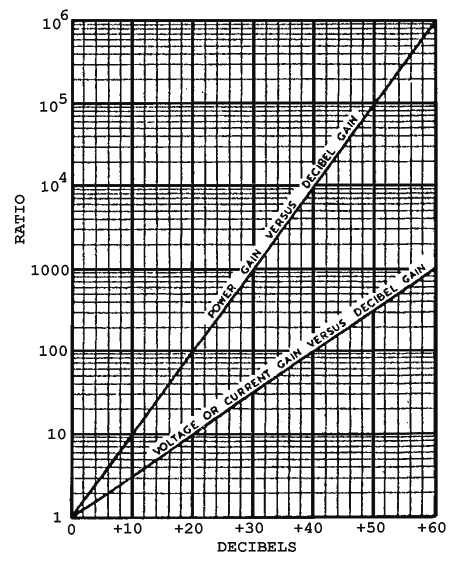
First, let's look at the graph with only two diagonal lines on it. I want you to see that current times voltage tells us how much power we have. In any given circuit, any change in either of voltage or current, changes the other by the same ratio. Thus, we can tell a power change ratio by observing a change in either voltage or current.
Graph of dB vs. ratios of voltage, current and power, 0 to 60 dB.
Because power is the multiple of the voltage and the current, these readings will change only by the square root of the power change. But we do not need to worry about that, either. All the charts and tables will let you use either power or your choice of voltage or current, without any square root, any multiplication -- at the most only simple addition or subtraction.
Look at DECIBELS, on the chart, out to +60, on the right edge. Now go up to the VOLTAGE OR CURRENT... line. It is at a RATIO of 1,000. Thus, it takes 1,000 times the VOLTAGE (or the CURRENT, because both change together in a given Load Z) to produce a +60 dB increase. How much is +60 dB in power? Look up to the POWER GAIN... line, to the top right corner. It is 106 (one followed by 6 zeros, or 1,000,000) a million to one.
Both 1,000 x either the voltage or the current = +60 dB, and 1,000,000 x the power (wattage) = +60 dB, because they are identical. To not get them confused is fundamental. (Like on your bicycle, you learned to turn in the direction that you were falling = no more spills.) Yes, in power, 60 dB means the digit "1" followed by 6 zeros, 40 dB = "1" & 4 zeros, etc. Of course, all of this in subtraction also applies.
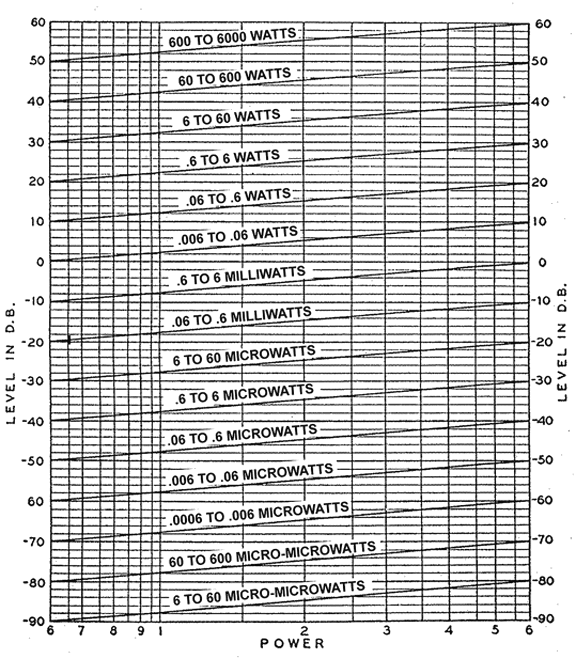
Graph of dB vs. power levels in watts.
In the second graph, with 15 slanting lines, we have a tremendous range of +60 dB, at the top left, to -90 dB, at the bottom, a difference of (+60 & -90 spread) 150 dB. A two meter repeater may go about that far, between the transmitter power of 100 watts (follow the POWER at the #"1") up to the level of "60 TO 600 WATTS" to read +42 dB. The 6 micro-micro watts at the bottom (today) is a good signal, at -90 dB.
This is only 132 dB difference, 1.6 watts (=2 dB) with 13 zeros after the decimal is 16,000,000,000,000 or 16 trillion to one in power.
Now look at the tables of dB values. They are all saying the same thing. They are just displayed differently. In any application, choose the one which lets you find your applicable numbers the easiest. When you have an answer from one graph or table, check it out on another, or even several of the others.
ISSUE NO. 68, February, 1989
Scanned, OCR'ed, and proofed by Bob "Bacon" Bruhns WA3WDR
Major Parts Sources To Dry Up?
AMers and other homebrewers, as well as non-radio hobbyists, craftsmen, small business entrepreneurs, and others whose operations depend on the availability of specialty items, now face a new threat from proposed government legislation. No, this is not a story about the latest FCC docket or yet another local zoning ordinance trying to legislate us out of existence, but an ongoing effort by state governments to enact federal legislation which would ultimately cause most mail-order sources of parts and equipment to dry up. Since your nearest Radio Shack is unlikely to carry much in way of tubes and transmitter parts, and there is probably no electronics surplus store at the local shopping mall, the primary remaining sources of this material, as well as all other specialty items (photographic, automotive, scientific, etc.), are the mail order outlets. When these sources are gone, there will only remain flea markets, swapfests and auctions - individuals trading among themselves - until existing supplies of material remaining in the hands of individuals are exhausted.
Mail order business is being threatened by federal legislation that would require catalogue firms to charge state sales taxes and forward that revenue back to the home state of each mail order customer. Unlike retail merchants which now must, at considerable expense and man-hours of paperwork, serve the function of tax collector for their home states, mail order firms would be forced to multiply all this bureaucratic red tape and paperwork by fifty, and simultaneously serve as tax collectors for every state in the union (except possibly for one or two states which still have no sales tax). It doesn't take tremendous intelligence or foresight to figure out what will happen if this legislation is allowed to pass. Many small parts suppliers and surplus equipment dealers are nothing more then "cottage industries," run by individuals out of their basements and garages, marginal operations at best. This additional tax collecting burden will simply force them out of business. The few remaining mail order outlets will pass the additional overhead expense on to the customer, resulting in higher prices for all goods, plus tax. And these will be large nation-wide "amateur radio supply houses" geared towards mainstream amateur radio, with all the new Yaesus and Kenwoods one could desire. The businesses to go under as a result of the proposed tax burden will be the small "Junkbox" suppliers which still offer vacuum tubes and the kinds of goodies sought by AMers and other homebrew artists.
The root of the problem is fiscal irresponsibility of government at all levels. After local, state and federal governments had overextended themselves for years, politicians at all levels began to recognize that the time is fast approaching to pay the piper. With election year pledges not to further "raise taxes" in the minds of voters, the federal government ended "revenue sharing" (free gifts of federal money to local governments), and cut many social programs for which the slack must now be taken up at the state and local levels. Financially strapped state and local governments are simultaneously feeling the squeeze from above and below and from all sides, and bureaucrats are single-mindedly grappling for revenue sources anywhere they think they might squeeze out a few more bucks without having to go on record as openly boosting existing tax rates. Recently, attention has been focused on mail order firms which ordinarily do not charge sales tax on out-of-state orders.
If mail order goods must be taxed, it would be far simpler to collect sales tax for the home state on all orders, regardless of where the customer lives. The catch to that approach is that the U.S. Supreme Court has already ruled it unconstitutional to charge local sales tax on out-of-state orders, but laws requiring mail order firms to collect and return taxes to the customer's home state are untried in the courts.
Anticipating passage of the federal legislation, Tennessee and several other states have already enacted state laws requiring residents who buy from out-of-state catalogue companies to pay sales tax to the home state, effective January 1, 1989. But the states are powerless to force out-of-state companies to collect taxes for them. State Senator Leonard Dunavant, who sponsored the Tennessee state law, remarked that lawmakers have done all they can and now need help from the U.S. Congress. "We'll just try to force our way in on it." Dunavant was quoted as saying. U.S. Representative Bart Gordon of Murphreesboro, TN, cosponsored the federal catalogue bill last year, but the measure never passed. Tennessee's U.S. congressional delegates will be lobbied to push for the federal legislation again. Similarly, other states have promised to simultaneously push to get the federal legislation passed.
Proponents of this federal legislation argue that their states are losing tens of millions of dollars annually in uncollected sales tax on out-of-state mail order goods. "It is not treating the business places in (the home state) fairly," they grumble. But compared to any state's total revenue, mail order losses are a drop in the bucket at most. Recovery of this loss does not justify the destruction of the mail order industry, which despite a few "bad apples" (see elsewhere in this issue), has served legitimate needs of the American public for over a century. If tax legislation forces the end of most catalogue sales, neither the states nor local firms will enjoy much additional revenue anyway. The claim of "unfairness" to local business firms is bogus. How many "local" retailers stock the kinds of specialty items sold by Fair Radio, L.L. Bean, J.C. Whitney and Antique Electronics Supply? If Fair Radio is forced out of the mail order business, AMers are not going to be putting more money into the local economy by purchasing modulation transformers and T-368's from K-Mart.
Very few consumers go to the trouble to mail order goods available at comparable prices at local retailers simply to get out of paying sales tax. Mail order is a considerable hassle already, involving filling in order blanks, supplying correct catalogue stock numbers, estimating shipping charges, satisfying minimum order requirements, and waiting sometimes for weeks for goods to arrive, at a substantial risk of shipping damage. In most cases, any money the customer saves on sales tax is more than absorbed by "handling fees" and shipping costs. (Have you tried shipping anything by parcel post or UPS lately?) The people most likely to order locally available retail items by mail are those who need this service to survive - the elderly and infirm who are physically unable to get out to the local shopping mall or discount warehouse.
Incidentally, the proponents of this federal legislation do not appear to be totally oblivious to the devastating effect it would have on mail order sales. A lawmaker from Kentucky was recently quoted in the newspaper as saying he thought the proposed legislation was doubly in the public interest because it would "reduce the volume of junk mail we receive by 90 percent." These lawmakers are knowingly willing to close down catalogue sales.
We must let our representatives in the Senate and Congress know our feelings on this issue. Remember, the legislation could pass without open debate; many of to-day's federal laws are enacted in an under-the-table manner, in the form of a sub-paragraph attached to some more prominent bill before Congress, which is totally unrelated to the subject legislation.
If you believe it to be in the public interest to maintain the availability of goods by mail order, it is strongly suggested that you take the time to look up the addresses of your representatives in the U.S. Congress and Senate, your state legislators, and the newly-elected read-my-lips-no-new-taxes President of the United States. Put your thoughts in writing, run off some photocopies, and drop each of them a line expressing your opposition to this proposed legislation. Be sure to rationally explain why you oppose a measure that promises to bring more revenue to your home state without creating "new" taxes or raising existing rates. Talk over this issue with others, on the air and in person. We must not allow the mail order industry to be killed by the single-minded ob$e$$ions of a few short-sighted politician$.
If you feel strongly on this issue, be sure to write a letter to the editor of your local newspaper. If every amateur radio operator who occasionally uses mail order service would get one letter printed in a local newspaper, millions of citizens nationwide, who otherwise would not bother to think this issue through, would be exposed to the opposing viewpoint.
Robert Stankus Update
Long-time AMers will recall RM-3665, a petition submitted to the FCC an April 15, 1980, by Robert W. Stankus, N1AAR, which sought to amend the amateur rules to eliminate the use of AM as a means of voice communication on all amateur bands. This petition contained the standard anti-AM tirade about technical progress and bandwidth, and in addition, argued that AM should be eliminated because "manufacturers no longer build equipment capable of delivering ...and receiving AM signals"!
Interestingly, the callsign N1AAR first became familiar to AMers prior to RM-3665 through the old Press Exchange, published by W2NRM in New Jersey, and predecessor to The AM Press/Exchange. Stankus ran display advertisements in issues number 2, 4 and 5 (1980) offering to sell vacuum tubes. Soon after its conception, Press Exchange began to run stories about rumours of petitions and another FCC action to ban AM from the amateur bands. Issue no. 3 printed "the following news from N1AAR. Did you know that there is presently before the FCC a petition for rulemaking calling for a maximum of 3.75 khz of space (sic) to be allotted to a phone signal. If that is passed and there is every likelihood it will, AM is dead, because there is no way that spec can be met. What we should be doing is fostering new and improved methods of voice communications. One that comes to mind is "Pulse Code Modulation". They are now making LP music records and the results are outstanding. No noise! Imagine that and all with just about zero bandwidth. Read up on this. It's the next major breakthrough in Ham Radio." This news item failed to mention that N1AAR was the originator of the petition.
Issue no. 4 published news of "proposed rulemaking #20889. ...Nestled in amongst the fine text is a paragraph calling for severe limitations on bandwidth as applied to voice communication (maximum 3.75 khz) ...this NPRM ...was originally filed in 1977 ...Portions of this news report supplied thru the courtesy of N1AAR..." Meanwhile, the N1AAR tube ads continued to run in Press Exchange.
Issue no. 6 continued to report on this story. An article titled "AM Under Fire" mentions "RM 20889", "another new bandwidth proposal", and "still another petition for the elimination of AM, filed April 15, 1980", continuing with verbatim excerpts from the text of RM-3665. Still no mention was made that Stankus was the author of the April 15 petition. However, the N1AAR tube ad no longer appeared in issue no. 6 or any subsequent issue. Issue no. 6 also printed a letter from WB4AIO who had checked with the FCC in Washington. Kevin reported that Docket 20889 existed but had nothing at all to do with amateur radio. He did report that a new bandwidth proposal was to be released in "June or July" (1980). In November, 1980, FCC released the infamous and ill-fated "Plain Language Rewrite." Nestled in the text was indeed a proposal calling for a maximum bandwidth of 7.0 khz for A3 emission (both AM and SSB).
Issue no. 7 of Press Exchange finally disclosed the full story on RM-3665, including the fact that it filed by N1AAR, based on information "received on May 29, 1980."
RM-3665 continued to be a topic of lively discussion in AM circles until news was received that on February 26, 1981, RM-3665 had been summarily dismissed by the FCC as having no merit. The Commission reported that it received 83 comments in this proceeding, in which only one comment supported the petition. Prompt action by the AM community nipped that one in the bud!
Ironically, in every likelihood, the ultimate result of Robert Stankus' petition was to strengthen the AM cause, by forcing the FCC to put on the official record that the continued use of AM in amateur radio is in the public interest. Also, this petition united the AM community, and provided the fledgeling Press Exchange with a ready-made crusade, allowing it to gain enough momentum to establish itself within the growing community of amateurs returning to AM phone. Events soon followed which clearly demonstrated the value of an amateur radio publication dedicated to AM. S.P.A.M. was to soon be reorganized to become much more effective in its endeavour to re-establish AM as an accepted facet of amateur radio. Press Exchange continued monthly publication for 36 issues until it ceased operations in December, 1982 due to the retirement of W2NRM and his decision to move to Florida.
Precisely when the AM community was suddenly and unexpectedly left without a publication, the FCC released Docket 82-624, the p.e.p. output proposal. Donald Chester, K4KYV, editor and publisher of The AM Press/Exchange, hurriedly threw together a packet of information on this ominous piece of legislation, obtained W2NRM's Press Exchange mailing list, and sent several hundred AMers full details on the docket and suggested effective action that could be taken to oppose the FCC's scheme to reduce the AM power limit.
The overwhelming response Don received from the AM community convinced him of the continuing need for some kind of AM publication, and thus The AM Press Exchange was born. The first issue arrived in the mail just five months after the demise of the original Press Exchange, using largely the same format. For the second time, a blow aimed against the AM community resulted in the establishment of an AM publication, and AM enthusiasts remained determined to keep their favorite mode a legitimate part of amateur radio.
Perhaps indulging in a little vindictiveness after the RM-3665 ordeal, many AMers openly expressed delight when the August, 1981 issue of Ham Radio magazine (on page 6) reported that Robert Stankus, N1AAR, operating a mail-order firm called Keswick Sales, had been indicted on 22 counts of using the U.S. mails to defraud, by a Federal grand jury in Roanoke, VA on June 10, 1981. Stankus had allegedly advertised new Kenwood TS-520SE's in the Ham Trader Yellow Sheets for the bargain price of $369.95 each. Eventually, more than 50 amateurs filed complaints with the Postal Service over his failure to deliver the rigs they had ordered through his ads. It was reported that Stankus actually did deliver a couple of transceivers, which he had purchased from legitimate dealers at near list prices.
At his first appearance before the judge on July 6, 1981, Stankus pleaded not guilty to all 22 counts. Facing a maximum fine of $1000 and five years in prison for each count, he decided to change his plea to guilty on 11 of the counts in return for having the 11 other charges dropped, according to a follow-up report published on page 10 of the November, 1981 issue of Ham Radio. It was not reported what sentence, if any, Stankus ultimately received for his part in the mail-order sales scheme. Justifiably or not, many AMers felt vindicated. This news story proved them right all along; the anti-AMer was publicly exposed as a villain while the AMers remained the "good guys".
epilogue
Recently, the name Robert Stankus appeared again in the amateur radio press. The January 20, 1989 issue of Westlink Report carries a news item on page 5, concerning experimental operation on 17 metres. The report, written by Fred Sontag, N0CAO, describes a group of amateurs with experimental licenses from the FCC, who are exploring the band with regular "skeds" on Saturday and Sunday at 1900 GMT on 18.111 mhz. According to the report the regular participants are Bill Orr, W6SAI (KM2XDW) in California; Stu Cowan, W2LX (KM2XDU) in New Hampshire; and N0CAO (KA2XAE) in Missouri, with occasional participation by Phil Galasso, K2PG (KA2XUK) in New Jersey, and ROBERT STANKUS, WS4I (KB2XCQ) in Virginia. For 17 metre operation, the experimental callsigns, indicated in parentheses, are used instead of regular amateur callsigns.
A "vanity" listing in the 1989 North American Callbook reveals the Richmond, VA address of Robert Stankus, WS4I. EDITOR'S NOTE: Out of fairness, our readers are reminded that, assuming Robert Stankus, WS4I, is indeed the same individual as N1AAR, there is nothing in this article or the quoted news reports to imply any impropriety in Mr. Stankus' present-day activities.
1989 WINTERFEST tm
Virginia (Vienna)--February 26, 1989.
Sponsor: Vienna Wireless Society 1989 Winterfest.
Time: Tailgate/Seller setup begins 6 AM, General Public 7:30 AM.
Place: Vienna Community Center 120 Cherry Street, Vienna, Virginia (off Route 123).
Features: Newly enlarged indoor exhibition area. Breakfast and lunch available.
Talk-in: K4HTA/R 146.085/146.685 or W4LBL/R 146.190/146.790.
Admission: $4.00 door, $7.00 tailgate, $10.00 (non commercial) and $15.00 (commerical) for indoor tables. (No advance door and/or tailgate sales.)
West Coast Report
by W6RNC
A/M activity for the fall and winter season has been down compared to last year, except for 10 meters. The 10 meter activity seems to have lured away almost all the 1885 kc. activity. 160 has been almost a ghost town this season, except for such stalwarts as NI6S, WD6EWE, W6RBZ and a couple of others.
The West Coast SPAM Wednesday night 9PM 3870 kc. schedule has been going very well, usually lasting for 3 hours with 10 or more check-ins. New SPAM A/M stations show up here from time to time. It seems that Oregon has produced the most newcomers lately, with KL7GKY/7 and K7CL (ex KL7CL) the most recent. Washington is doing very well, Idaho and Colorado are in from time to time. California seems to be in the doldrums--especially northern California.
The SPAM Sunday 4PM 7156 kc schedule is holding its own with 5 or 6 regulars. Attention East Coast and Central SPAM members! Many non-SPAM members have appeared on 10 meter A/M with the advent of good band conditions. It would be helpful, when you are qso-ing with these W6 stations, if you would please let them know of the West Coast A/M activity on other bands, where they would be very welcome to check in.
Murphy Strikes AM P/X (again ... and again)
After the December/January issue was sent to the printer, with the explanation of the expected delay in publication, Murphy struck again and five additional days of delay were added. We ran out of the special staples used in the saddle stapler which fastens each copy together. No office supply store in town keeps these in stock, so more were ordered while publication was put on hold. We were promised delivery within two days, but three days later when the staples arrived they were the wrong size. They were re-ordered, with delivery promised the next day. We checked the next day; the package was "left off the truck by mistake." A phone call assured us that the staples would arrive the following day. Once again the box "was not loaded on the truck." Issue no. 67 had been lying around for nearly a week now, waiting for staples. So we decided to mail the remaining copies without staples rather than delay publication any further. About 25 percent of our subscribers were affected. If your AM P/X arrived without staples last month, rest assured that this and all subsequent issues will be stapled together as usual. By the way, as you might have guessed, the new supply of staples arrived the same day the stapleless copies were assembled and mailed out.
Everything was on track this month, and we had anticipated getting the February issue out on schedule, but The AM Press/Exchange continues to be plagued by Murphy's Law. Don Chester, editor and publisher, learned that his son has a serious bone infection which will require several weeks of treatment. This is the same child who was attacked by loose dogs in October, 1987. Doctors do not believe his present condition is related to injuries resulting from the dog attack. Don in now trying to care for the 2-1/2 year old daughter while his wife is occupied with their son, still maintaining the schedule of teaching at two different schools. Once again this month, AM P/X is sitting unattended, and as of this writing, Don has no idea when this issue will eventually be delivered.
How Do We Spell Relief? Q-S-Y
WB2KPH
The following information concerning the packet radio signal on 29.050 mhz was received by Mike, WB2KPH, on his local packet BBS. The signal has been causing considerable disruption to AM operators using the 29.0 - 29.2 mhz "AM Window".
(Message received on January 10, 1989.)
[5945] BF BID: 41441_N4QQ
Paths WB3DNQ!WA3ZNW!N4QQ
Date: 10 Jan 88 03:36:16 E
From: K3AKK@N4QQ
To: ALL@MDCBBS
Subject: NATCAP 29.050 Node off the air
The K3AF-7 / NATCAP node on 29.050 has been temporarily removed from service pending a decision at FCC on the necessity for and/or desirability of issuing a Special Temporary Authorization for its operation at 1200 baud packet on FM AFSK at that frequency in the 10 meter band. It was determined that there appears to be no specific FCC Part 97 authorization for that mode of operation on 10 meters. The node had been providing 6 hour a day connectivity to the AZSE node and the 145.01 network in Arizona. Informed opinions are welcome.
73, Dick - K3AKK @ N4QQ, sysop DCA nodes
DE WB3DNQ BBS (B,D,H,I,J,K,L,N,R,S,T,U,V,W,X,Y,?) )
(Update received on January 13, 1989.)
[6036] BF BID: 41736_N4QQ
Path: WB3DNQ!WA3ZNW!N4QQ
Date: 13 Jan 88 00:26:46 E
From: K3AKK@N4QQ
To: ALL@MDCBBS
Subject: More: NATCAP Node Changes
Two days ago, the NATCAP node which operates on 29.050 1200 baud FM and the connecting node, AZSE in Arizona was taken off the air when it was determined that there was no specific authorization for FM AFSK packet on ten meters. I have since been advised that it WAS the intent of the FCC to not authorize this mode while, at the same time, authorizing other wide band modes such as FM voice and AM on ten meters. This is understandable, as there were many active voice stations at the time the regulations were drawn and few packet stations. While a Special Temporary Authorization might be requested, I was advised by Paul Rinaldo at ARRL that ARRL probably would not support the STA when the FCC asked for its comments. This position could be changed by action of the ARRL Board. It would require action on the part of packet operators to make their desires known to their Division Directors. While there is a Board meeting this coming week, I would not think that any action might be taken on this situation, as it is not on the agenda for the meeting. I would guess that we would be on the downside of the current solar cycle before there would be a favorable decision.
So,..... the NATCAP and AZSE modes will be moving to 28.205, 1200 baud, FSK. Tests run today indicate that this circuit does reflect the calculated 6 dB advantage over the old FM circuit. When NATCAP reappears in the node tables next week, it will be on the new frequency and connecting to AZSE in Arizona and COLO10 in Colorado Springs, CO. Both distant nodes access their 145.01 networks. The WASHDC node will remain on 28.105, 300 baud, FSK. Both nodes will be at the Silver Hill site with 300 feet vertical separation between antennas and cross polarization providing protection from receiver desense. The WASHDC node uses an ICOM 730 and the NATCAP node a Drake TR-7. The WASHDC node uses an AEA PM-1 HF adapter & TNC-200 and the NATCAP node uses a TNC-200 modified for variable threshold DCD and true tone data carrier detect. A ten meter bandpass cavity filter, if one could be found, might improve the operation.
In summary, NATCAP will return to the air in a few days connecting not only to AZSE but also to COLO10. The packets will flow much faster on the new circuit. This circuit is on 28.205, 1200 baud. (The dial frequency is 28.205 and the mode is lower sideband using standard 1200/2200 tones.)
Dick - K3AKK @ N4QQ
DE WB3DNQ BBS (B,D,H,I,J,K,L,N,R,S,T,U,V,W,X,Y?) )
THE REAL VOICE OF AMERICA * AMATEUR RADIO
Dear Editor: The 75 meter AM Thanksgiving Homecoming Jamboree on Friday and Saturday after Thanksgiving was very pleasant, even though we neglected to talk it up the weeks before. Maybe next year I shall remember to insert a notice in your Thanksgiving issue.
With ten meters opening up, we are receiving calls on 28.706 from old neighbors on AM who have moved to Fla., Texas, Arizona, Colo., Ore., Wash., etc. Forty years ago when ten meters was much busier than today (my dad had 235 10 meter mobilers on his transmitter hunt list in north Jersey) our primary operating frequency was 28.706 and our secondary AM mobile frequency was 29.400. Today I suggest 28.7 to 28.71 as a good primary AM frequency. For many decades I have monitored 28.706 continually.
Of late while on ten meters I often call "CQ freedom of speech" and I am happy to report that several Europeans did respond, even though their governments do not protect and preserve their God-given privilege to speak freely. I am sorry to report that I have not had a free provocative conversation with any of the many Russians who call me, and Mr. Gorbachev never responded to my July letter concerning individual radio broadcasting between we-the-people in Russia and America.
73 & 76, Irb, W2VJZ, Liberty Or!, NJ 07938
MAKING AM THE GREAT NEW GUY ON THE BLOCK
or HOW YOU CAN GREATLY OVERCOME POWER LIMITATIONS ON AM
Copyrighted, 1989, by George A. H. Bonadio, W2WLR
Watertown, NY 13601-3829Part 4
To Understand Radio, We Understand Decibels
Isn't it interesting! In every important text in radio there are anywhere from one to six pages of tables explaining decibels, dB. Oh, but not in some amateur text, which survives from advertisers who are selling very expensive decibels of radio gear, will you see any tables of dB.
Yes, comparing decibels and dollars, dB and $ is what this is all about. Efficiency is rated in dB and cost is rated in $. We now need a "feel for dB" just as we have learned to "feel for $". It is easy. It's something like riding a bicycle. Once you learn to go with it, it's the easiest way to go.
First, dB's are shortcuts for us who do not like to multiply or to divide more than one digit at a time. The dB way is to add dB in place of multiplying, and to subtract dB in place of dividing. (Like a bicycle has eliminated two wheels on the ground, a motor, glass, oil, gasoline, etc.) Because all electronic signals go through stage after stage of both amplifiers (gain) and resistances (loss), the cascading, end to end, of these gain or loss multipliers (gain) or dividers (loss) can be written in dB, and the dB of each stage is (simply) added to (+) or subtracted from (-) the starting dB level, and the result is a true figure, without any multiplying or any dividing. dB are neat.
First, let's look at the graph with only two diagonal lines on it. I want you to see that current times voltage tells us how much power we have. In any given circuit, any change in either of voltage or current, changes the other by the same ratio. Thus, we can tell a power change ratio by observing a change in either voltage or current.
Graph of dB vs. ratios of voltage, current and power, 0 to 60 dB.
Because power is the multiple of the voltage and the current, these readings will change only by the square root of the power change. But we do not need to worry about that, either. All the charts and tables will let you use either power or your choice of voltage or current, without any square root, any multiplication -- at the most only simple addition or subtraction.
Look at DECIBELS, on the chart, out to +60, on the right edge. Now go up to the VOLTAGE OR CURRENT... line. It is at a RATIO of 1,000. Thus, it takes 1,000 times the VOLTAGE (or the CURRENT, because both change together in a given Load Z) to produce a +60 dB increase. How much is +60 dB in power? Look up to the POWER GAIN... line, to the top right corner. It is 106 (one followed by 6 zeros, or 1,000,000) a million to one.
Both 1,000 x either the voltage or the current = +60 dB, and 1,000,000 x the power (wattage) = +60 dB, because they are identical. To not get them confused is fundamental. (Like on your bicycle, you learned to turn in the direction that you were falling = no more spills.) Yes, in power, 60 dB means the digit "1" followed by 6 zeros, 40 dB = "1" & 4 zeros, etc. Of course, all of this in subtraction also applies.
Graph of dB vs. power levels in watts.
In the second graph, with 15 slanting lines, we have a tremendous range of +60 dB, at the top left, to -90 dB, at the bottom, a difference of (+60 & -90 spread) 150 dB. A two meter repeater may go about that far, between the transmitter power of 100 watts (follow the POWER at the #"1") up to the level of "60 TO 600 WATTS" to read +42 dB. The 6 micro-micro watts at the bottom (today) is a good signal, at -90 dB.
This is only 132 dB difference, 1.6 watts (=2 dB) with 13 zeros after the decimal is 16,000,000,000,000 or 16 trillion to one in power.
Now look at the tables of dB values. They are all saying the same thing. They are just displayed differently. In any application, choose the one which lets you find your applicable numbers the easiest. When you have an answer from one graph or table, check it out on another, or even several of the others.
Table of Voltage, Current or Power Ratios vs. dB
Voltage or Current
RatioPower Ratio dB Voltage or Current Ratio Power
RatioVoltage or Current
RatioPower Ratio dB Voltage or Current Ratio Power
Ratio1.0000 1.00000 0.0 1.000 1.000 0.1995 0.03981 14 5.012 25.12 0.9886 0.97724 0.1 1.012 1.023 0.1778 0.03162 15 5.623 31.62 0.9772 0.95499 0.2 1.023 1.047 0.1585 0.02512 16 6.310 39.81 0.9661 0.93325 0.3 1.035 1.072 0.1413 0.01995 17 7.079 50.12 0.9550 0.91201 0.4 1.047 1.096 0.1259 0.01585 18 7.943 63.10 0.9441 0.89125 0.5 1.059 1.122 0.1122 0.01259 19 8.913 79.43 0.9333 0.87096 0.6 1.072 1.148 0.1000 0.01000 20 10.000 100.00 0.9120 0.83176 0.8 1.096 1.202 0.0891 0.00794 21 11.22 125.9 0.8913 0.79433 1.0 1.122 1.259 0.0794 0.00631 22 12.59 158.5 0.8414 0.70795 1.5 1.189 1.413 0.0708 0.00501 23 14.13 199.5 0.7943 0.63096 2.0 1.259 1.585 0.0631 0.00398 24 15.85 251.2 0.7499 0.56234 2.5 1.334 1.778 0.0562 0.00316 25 17.78 316.2 0.7079 0.50119 3.0 1.413 1.995 0.0501 0.00251 26 19.95 398.1 0.6310 0.39811 4.0 1.585 2.512 0.0447 0.00200 27 22.39 501.2 0.5623 0.31623 5.0 1.778 3.162 0.0398 0.00158 28 25.12 631.0 0.5012 0.25119 6.0 1.995 3.981 0.0355 0.00126 29 28.18 794.3 0.4467 0.19953 7.0 2.239 5.012 0.0316 0.00100 30 31.62 1,000 0.3981 0.15849 8.0 2.512 6.310 0.0282 0.00079 31 35.48 1,259 0.3548 0.12589 9.0 2.818 7.943 0.0251 0.00063 32 39.81 1,585 0.3162 0.10000 10 3.162 10.000 0.0224 0.00050 33 44.67 1,995 0.2818 0.07943 11 3.548 12.59 0.0200 0.00040 34 50.12 2,512 0.2512 0.06310 12 3.981 15.85 0.0178 0.00032 35 56.23 3,162 0.2239 0.05012 13 4.467 19.95 0.0158 0.00025 36 63.10 3,981
Table of Voltage, Current or Power Ratios vs. dB
Voltage or Current
RatioPower Ratio dB Voltage or Current Ratio Power
RatioVoltage or Current
RatioPower Ratio dB Voltage or Current Ratio Power
Ratio1.0000 1.00000 0.0 1.000 1.000 0.1995 0.03981 14 5.012 25.12 0.9886 0.97724 0.1 1.012 1.023 0.1778 0.03162 15 5.623 31.62 0.9772 0.95499 0.2 1.023 1.047 0.1585 0.02512 16 6.310 39.81 0.9661 0.93325 0.3 1.035 1.072 0.1413 0.01995 17 7.079 50.12 0.9550 0.91201 0.4 1.047 1.096 0.1259 0.01585 18 7.943 63.10 0.9441 0.89125 0.5 1.059 1.122 0.1122 0.01259 19 8.913 79.43 0.9333 0.87096 0.6 1.072 1.148 0.1000 0.01000 20 10.000 100.00 0.9120 0.83176 0.8 1.096 1.202 0.0891 0.00794 21 11.22 125.9 0.8913 0.79433 1.0 1.122 1.259 0.0794 0.00631 22 12.59 158.5 0.8414 0.70795 1.5 1.189 1.413 0.0708 0.00501 23 14.13 199.5 0.7943 0.63096 2.0 1.259 1.585 0.0631 0.00398 24 15.85 251.2 0.7499 0.56234 2.5 1.334 1.778 0.0562 0.00316 25 17.78 316.2 0.7079 0.50119 3.0 1.413 1.995 0.0501 0.00251 26 19.95 398.1 0.6310 0.39811 4.0 1.585 2.512 0.0447 0.00200 27 22.39 501.2 0.5623 0.31623 5.0 1.778 3.162 0.0398 0.00158 28 25.12 631.0 0.5012 0.25119 6.0 1.995 3.981 0.0355 0.00126 29 28.18 794.3 0.4467 0.19953 7.0 2.239 5.012 0.0316 0.00100 30 31.62 1,000 0.3981 0.15849 8.0 2.512 6.310 0.0282 0.00079 31 35.48 1,259 0.3548 0.12589 9.0 2.818 7.943 0.0251 0.00063 32 39.81 1,585 0.3162 0.10000 10 3.162 10.000 0.0224 0.00050 33 44.67 1,995 0.2818 0.07943 11 3.548 12.59 0.0200 0.00040 34 50.12 2,512 0.2512 0.06310 12 3.981 15.85 0.0178 0.00032 35 56.23 3,162 0.2239 0.05012 13 4.467 19.95 0.0158 0.00025 36 63.10 3,981
Table of Power, Voltage or Current Ratios vs. dB
Power
RatioVoltage
or
Current
RatiodB Power
RatioVoltage
or
Current
RatiodB 1.0000 1.0000 0.0 1.7378 1.3183 2.4 1.0233 1.0116 0.1 1.8197 1.3490 2.6 1.0471 1.0233 0.2 1.9055 1.3804 2.8 1.0715 1.0351 0.3 1.9953 1.4125 3.0 1.0965 1.0471 0.4 2.2387 1.4962 3.5 1.1220 1.0593 0.5 2.5119 1.5849 4.0 1.1482 1.0715 0.6 2.8184 1.6788 4.5 1.1749 1.0839 0.7 3.1623 1.7783 5.0 1.2023 1.0965 0.8 3.5481 1.8836 5.5 1.2303 1.1092 0.9 3.9811 1.9953 6.0 1.2589 1.1220 1.0 5.0119 2.2387 7.0 1.3183 1.1482 1.2 6.3096 2.5119 8.0 1.3804 1.1749 1.4 7.9433 2.8184 9.0 1.4454 1.2023 1.6 10.0000 3.1623 10 1.5136 1.2303 1.8 12.589 3.5481 11 1.5849 1.2589 2.0 15.849 3.9811 12 1.6596 1.2882 2.2 19.953 4.4668 13 Table of Voltage, Current or Power Ratios vs. dB
Voltage or Current
RatioPower Ratio dB Voltage or Current Ratio Power
RatioVoltage or Current
RatioPower Ratio dB Voltage or Current Ratio Power
Ratio1.0000 1.00000 0.0 1.000 1.000 0.1995 0.03981 14 5.012 25.12 0.9886 0.97724 0.1 1.012 1.023 0.1778 0.03162 15 5.623 31.62 0.9772 0.95499 0.2 1.023 1.047 0.1585 0.02512 16 6.310 39.81 0.9661 0.93325 0.3 1.035 1.072 0.1413 0.01995 17 7.079 50.12 0.9550 0.91201 0.4 1.047 1.096 0.1259 0.01585 18 7.943 63.10 0.9441 0.89125 0.5 1.059 1.122 0.1122 0.01259 19 8.913 79.43 0.9333 0.87096 0.6 1.072 1.148 0.1000 0.01000 20 10.000 100.00 0.9120 0.83176 0.8 1.096 1.202 0.0891 0.00794 21 11.22 125.9 0.8913 0.79433 1.0 1.122 1.259 0.0794 0.00631 22 12.59 158.5 0.8414 0.70795 1.5 1.189 1.413 0.0708 0.00501 23 14.13 199.5 0.7943 0.63096 2.0 1.259 1.585 0.0631 0.00398 24 15.85 251.2 0.7499 0.56234 2.5 1.334 1.778 0.0562 0.00316 25 17.78 316.2 0.7079 0.50119 3.0 1.413 1.995 0.0501 0.00251 26 19.95 398.1 0.6310 0.39811 4.0 1.585 2.512 0.0447 0.00200 27 22.39 501.2 0.5623 0.31623 5.0 1.778 3.162 0.0398 0.00158 28 25.12 631.0 0.5012 0.25119 6.0 1.995 3.981 0.0355 0.00126 29 28.18 794.3 0.4467 0.19953 7.0 2.239 5.012 0.0316 0.00100 30 31.62 1,000 0.3981 0.15849 8.0 2.512 6.310 0.0282 0.00079 31 35.48 1,259 0.3548 0.12589 9.0 2.818 7.943 0.0251 0.00063 32 39.81 1,585 0.3162 0.10000 10 3.162 10.000 0.0224 0.00050 33 44.67 1,995 0.2818 0.07943 11 3.548 12.59 0.0200 0.00040 34 50.12 2,512 0.2512 0.06310 12 3.981 15.85 0.0178 0.00032 35 56.23 3,162 0.2239 0.05012 13 4.467 19.95 0.0158 0.00025 36 63.10 3,981
You can run your favorite tables and graphs through copying machines which enlarge up to full sheet size, and make several copies, including one to drop solder onto.
Let's run an example. Earlier in this series, I showed you how to save +2 dB by shunting out your ground losses. Look on the tables to find a 0 level of dB, and then about +2 dB up from that you should find a number close to 1.6 power. That is 160% of your former power level in both your transmitting and your receiving.
If you butchered your transmitter final and power supply and modulators, you might (just might) do it for $100. Then, a good preamplifier in front of your receiver might give you a +2 dB improvement in receiving signal to noise ratio, but not against local noises. There could go another $30.
However, the technique I have shown you would do it faster, easier and for, perhaps, only $10 for new and coated copper wire (the best). Go ahead, compare the costs per dB between the two ways. The cheaper way is at least 5:1 better and costs less to operate and less to maintain and has advantages on receiving which no new "front end" can substitute for.
And, anytime you do spend $ for new gear to hook onto it, that, also, will operate at +2 dB better in and out, at no increase in price. Pay attention to $/dB, dollars per dB, and come up with a ratio before you spend your money.
For example, we have a repeater (mostly from gifts, some "depreciated") that adds up, in original costs, not counting the antenna support, to $13,000. Since -3dB would be a loss of 50% of power and 50% of sensitivity, that would be a loss of $6,500. If we divide $6,500 by 3 (dB) we have $2,166 per dB.
If the receiving is, say, half of the station, receiving is only $1,083 per dB. So I spent, in total, another $150 for a second stage of front end GaAsFET. It helped weak signal noise by -2dB, at about $75/dB when those dB cost over $1,000 each, new. Good deal.
Or, for another example, from the Antenna Elevation Table in another part of this series, you could run your 250 watt AM ("Angel Music"?) (compared to SSB "Scientific Set Back"?) station up to 1,000 watts for $600. That's +6dB (find it on the tables). It will not, however, help your receiving. With antenna elevation (shown later), you can gain +6dB on both transmitting and receiving for even, say, $600. This helps receiving in the "if you can't hear them, you can't work them" department.
It reduces line noise to signal ratio, too, but more on that later. At no increase in electric costs, parts replacements upkeep, excess heat in the shack and with valuable improvements in receiving, at the same costs. Money spent on that antenna situation is better than the same $ on the transmitter.
Meanwhile, learn that 6dB is a 4:1 power ratio, that 3dB is a 2:1 ratio. 10db is 10:1 power. 20dB is 100:1 power. 30dB is 1,000:1 power. Even that +2dB is 160% of power. Ignore the fractions. Think in terms of dB, and, for your pocketbook's sake, think in terms of $/dB.
NORTHEAST AM SCENE
by Bill Wolf - KA2EEV
ENGLISH CHANNEL: As a result of the current long haul DX on 10 meters there's been quite a good share of AM coming across from Great Britain these days. The propagation path favors England (and Western Europe) during the morning hours between 9 - 11 a.m. (E.S.T.) on 29.0 thru 29.1 MHz. Among the British AM chaps are G0EHQ, G0EB, and G3GGS. Most popular, however, and heard most frequently is Jerry, G0AQH, who runs 35 watts of true plate modulated AM as opposed to the "low level modulation" usually heard on import rigs from overseas AMers. Jerry's tube type transmitter is nearly equivalent to what we commonly know here in the states as a Johnson Ranger with a single 6146 in the final. His AM receiver is an SP-600.
FAT SIGNAL: Les, W1FAT, already had a notably improved signal with his new antenna and new QTH in Maine. Now Les is even stronger and sounding better than ever with his recently acquired kilowatt rig ... an old commercially made transmitter by ERCO. The fat signal gives Les more opportunity for might operation since W1FAT can now more easily slice through those prime time hours.
NEW KID ON THE BLOCK: Sally, KA8UVQ, of Winthrop, Maine, (formerly from Cleveland) is among our newcomers to the northeast AM scene. Sally runs a Ranger and she's mostly active in the evening on 75 meters and occasionally works 7295 KHz daytime.
OLD KID ON A NEW BLOCK: Byron, W2JTP, formerly of Long Island and now living near Seattle writes to say that he's hearing several of our northeast AMers out on the west coast. Included are WA1HLR, N2INR, K2LYC, and WA3PUN. Byron says he's in there pitching on AM from his new QTH but the pitching is extremely difficult out west due to very heavy SSB and other "noise factors". (Sounds like it might be more bitching than pitching) Byron also asked me to extend warm wishes to his many AM friends back here on the east coast.
COMING NEXT MONTH: Nets and nuts.
PLAN TO ATTEND THE DAYTON HAMVENTION APRIL 28,29,30 1989
DON'T MISS THE AM FORUM 2:30 SATURDAY, APRIL 29, 1989
EXCHANGE
WANTED: Old (but good) xmtg. crystals in round holders with pins out bottom - Bliley preferred - on CW and phone frequencies in 160-20 mtr. bands. Also want small, 4-pin, plug-in, phenolic coil forms, 4, 5, 6, and 7-pin ceramic wafer (flat) tube sockets with mounting holes, porcelain "UV" type socket for type VT-2 tube, bakelite panel approx. 10"x14", National "Velvet Vernier" type B or BM dial, "Coto-coil" wheel-type knobs and scales, 872(A) tubes, Gonset or similar mobile rcvg converter for h.f. amateur and shortwave bands w/bc band output.
FOR SALE/TRADE: stereo patch panels 52 jacks, $30 each. 3B28's $9 each tested. Antique signal generator Ferris 18B Microvolter $35. U ship all.
WANTED: Harvey Wells TBS-50A (or any series) transmitter with tubes in good physical condition (not required to operate) Meissner Signal Shifter, Model 9-1077/80 (plug-in coils type) in good physical condition (not required to operate).
WANTED: Audio transformers U.T.C. LS-49 and Chicago BD-2.
WANTED: Receivers R7 and National NC-240D.WANTED: AM enthusiast engaged in RF combat with vicious SSB operators needs the following parts for victory - two four pin jumbo tube sockets for 872, 810, etc, and a couple of good 810's. State price and condition. Also need 872 MV rectifiers. Have good 833A available - trades? Also have some BC-610 parts available (sorry, previous owner looted unit, no breadslicers or plate transformer).
FOR SALE: 3 new Los Gatos 6146B's $20 all. Johnson T/R switch 250-39 $5. Sony ICF-2010 narrow filter kit $10. Radiokit's general coverage adaptor for Drake R4 series - unassembled kit $40. I ship.
FOR SALE: HALLICRAFTERS SERVICE MANUALS. I just received a good supply of originals. Will supply a copy to anyone who needs one for the cost of postage and copying, $3.00 total per copy. If I can be of help to anyone working on old Hallicrafters gear, let me know.
WANTED: Heathkit HW22A (40 mtr) transceiver and power supply in good physical and operating condition. Harvey Wells TBS-50A 40 w. transmitter with tubes in good physical condition, need not be in operating condition. Millen Rack Mount 90800 transmitter-exciter with tubes in good physical condition, need not be in operating condition.
FOR SALE: 1625 tubes $3 each. 807's $3 each. 805's $20 each. 813's $20 each. Miniatures $1 each. Octals and Loctals $2 each. Components, chokes, power transformers, modulation transformers inquire.
WANTED: AM transmitter and receiver in good working condition.
WANTED: Manual for Heathkit TX-1 Apache transmitter. Manual must be dated 4-29-60 or later and give neutralisation procedures.
WANTED: Lafayette Comstat 23 or 25 series CB transceivers reasonable condition.
FOR SALE: Technical Materiel GPT-750 1 KW OUTPUT 2-32 mhz CW-FSK transmitter in excellent condition, complete, $800.
FOR SALE: Collins 30K1 with remote VFO. Final needs rebuilding. Excellent condx with spares. $300.
WANTED: Need manual or information on Millen 90800 rackmount exciter/transmitter and power supply for same if anyone has it. Need crystals for AM frequencies to use with this exciter/xmtr. Also need U.T.C. audio transformer LS-47 (or equivalent). Would like to buy or trade for a Collins 75A3 receiver in good condition.
WANTED: Low voltage transformer for Viking Valiant.
WANTED: Impedance connection chart for Thordarson 300 w. multimatch modulation transformer T-21M64. Also wanted: Elmac AF-67 transmitter.
WANTED: HDVL, TVL and JCL tank coils for 16O m.
WANTED: Hookup info for Merit A-3106 modulation transformer.
This is the AM PRESS:
An amateur radio publication dedicated to Amplitude Modulation.
This is the AM EXCHANGE:
Offering FREE ADVERTISING to enhance the availability of AM equipment and parts.
DISPLAY ADVERTISING: Rates upon request.
Edited and published by Donald Chester, K4KYV
NOTICE: The purpose of this publication is the advancement of Amplitude Modulation in the Amateur Radio Service, and there is no pecuniary Interest. Therefore, permission is hereby expressed for the use of material contained herein without permission of the publisher, with the exception of specifically copyrighted articles, provided that The AM Press/Exchange is properly credited.
ISSUE NO. 68, February, 1989
Scanned, OCR'ed, and proofed by Bob "Bacon" Bruhns WA3WDR
Major Parts Sources To Dry Up?
AMers and other homebrewers, as well as non-radio hobbyists, craftsmen, small business entrepreneurs, and others whose operations depend on the availability of specialty items, now face a new threat from proposed government legislation. No, this is not a story about the latest FCC docket or yet another local zoning ordinance trying to legislate us out of existence, but an ongoing effort by state governments to enact federal legislation which would ultimately cause most mail-order sources of parts and equipment to dry up. Since your nearest Radio Shack is unlikely to carry much in way of tubes and transmitter parts, and there is probably no electronics surplus store at the local shopping mall, the primary remaining sources of this material, as well as all other specialty items (photographic, automotive, scientific, etc.), are the mail order outlets. When these sources are gone, there will only remain flea markets, swapfests and auctions - individuals trading among themselves - until existing supplies of material remaining in the hands of individuals are exhausted.
Mail order business is being threatened by federal legislation that would require catalogue firms to charge state sales taxes and forward that revenue back to the home state of each mail order customer. Unlike retail merchants which now must, at considerable expense and man-hours of paperwork, serve the function of tax collector for their home states, mail order firms would be forced to multiply all this bureaucratic red tape and paperwork by fifty, and simultaneously serve as tax collectors for every state in the union (except possibly for one or two states which still have no sales tax). It doesn't take tremendous intelligence or foresight to figure out what will happen if this legislation is allowed to pass. Many small parts suppliers and surplus equipment dealers are nothing more then "cottage industries," run by individuals out of their basements and garages, marginal operations at best. This additional tax collecting burden will simply force them out of business. The few remaining mail order outlets will pass the additional overhead expense on to the customer, resulting in higher prices for all goods, plus tax. And these will be large nation-wide "amateur radio supply houses" geared towards mainstream amateur radio, with all the new Yaesus and Kenwoods one could desire. The businesses to go under as a result of the proposed tax burden will be the small "Junkbox" suppliers which still offer vacuum tubes and the kinds of goodies sought by AMers and other homebrew artists.
The root of the problem is fiscal irresponsibility of government at all levels. After local, state and federal governments had overextended themselves for years, politicians at all levels began to recognize that the time is fast approaching to pay the piper. With election year pledges not to further "raise taxes" in the minds of voters, the federal government ended "revenue sharing" (free gifts of federal money to local governments), and cut many social programs for which the slack must now be taken up at the state and local levels. Financially strapped state and local governments are simultaneously feeling the squeeze from above and below and from all sides, and bureaucrats are single-mindedly grappling for revenue sources anywhere they think they might squeeze out a few more bucks without having to go on record as openly boosting existing tax rates. Recently, attention has been focused on mail order firms which ordinarily do not charge sales tax on out-of-state orders.
If mail order goods must be taxed, it would be far simpler to collect sales tax for the home state on all orders, regardless of where the customer lives. The catch to that approach is that the U.S. Supreme Court has already ruled it unconstitutional to charge local sales tax on out-of-state orders, but laws requiring mail order firms to collect and return taxes to the customer's home state are untried in the courts.
Anticipating passage of the federal legislation, Tennessee and several other states have already enacted state laws requiring residents who buy from out-of-state catalogue companies to pay sales tax to the home state, effective January 1, 1989. But the states are powerless to force out-of-state companies to collect taxes for them. State Senator Leonard Dunavant, who sponsored the Tennessee state law, remarked that lawmakers have done all they can and now need help from the U.S. Congress. "We'll just try to force our way in on it." Dunavant was quoted as saying. U.S. Representative Bart Gordon of Murphreesboro, TN, cosponsored the federal catalogue bill last year, but the measure never passed. Tennessee's U.S. congressional delegates will be lobbied to push for the federal legislation again. Similarly, other states have promised to simultaneously push to get the federal legislation passed.
Proponents of this federal legislation argue that their states are losing tens of millions of dollars annually in uncollected sales tax on out-of-state mail order goods. "It is not treating the business places in (the home state) fairly," they grumble. But compared to any state's total revenue, mail order losses are a drop in the bucket at most. Recovery of this loss does not justify the destruction of the mail order industry, which despite a few "bad apples" (see elsewhere in this issue), has served legitimate needs of the American public for over a century. If tax legislation forces the end of most catalogue sales, neither the states nor local firms will enjoy much additional revenue anyway. The claim of "unfairness" to local business firms is bogus. How many "local" retailers stock the kinds of specialty items sold by Fair Radio, L.L. Bean, J.C. Whitney and Antique Electronics Supply? If Fair Radio is forced out of the mail order business, AMers are not going to be putting more money into the local economy by purchasing modulation transformers and T-368's from K-Mart.
Very few consumers go to the trouble to mail order goods available at comparable prices at local retailers simply to get out of paying sales tax. Mail order is a considerable hassle already, involving filling in order blanks, supplying correct catalogue stock numbers, estimating shipping charges, satisfying minimum order requirements, and waiting sometimes for weeks for goods to arrive, at a substantial risk of shipping damage. In most cases, any money the customer saves on sales tax is more than absorbed by "handling fees" and shipping costs. (Have you tried shipping anything by parcel post or UPS lately?) The people most likely to order locally available retail items by mail are those who need this service to survive - the elderly and infirm who are physically unable to get out to the local shopping mall or discount warehouse.
Incidentally, the proponents of this federal legislation do not appear to be totally oblivious to the devastating effect it would have on mail order sales. A lawmaker from Kentucky was recently quoted in the newspaper as saying he thought the proposed legislation was doubly in the public interest because it would "reduce the volume of junk mail we receive by 90 percent." These lawmakers are knowingly willing to close down catalogue sales.
We must let our representatives in the Senate and Congress know our feelings on this issue. Remember, the legislation could pass without open debate; many of to-day's federal laws are enacted in an under-the-table manner, in the form of a sub-paragraph attached to some more prominent bill before Congress, which is totally unrelated to the subject legislation.
If you believe it to be in the public interest to maintain the availability of goods by mail order, it is strongly suggested that you take the time to look up the addresses of your representatives in the U.S. Congress and Senate, your state legislators, and the newly-elected read-my-lips-no-new-taxes President of the United States. Put your thoughts in writing, run off some photocopies, and drop each of them a line expressing your opposition to this proposed legislation. Be sure to rationally explain why you oppose a measure that promises to bring more revenue to your home state without creating "new" taxes or raising existing rates. Talk over this issue with others, on the air and in person. We must not allow the mail order industry to be killed by the single-minded ob$e$$ions of a few short-sighted politician$.
If you feel strongly on this issue, be sure to write a letter to the editor of your local newspaper. If every amateur radio operator who occasionally uses mail order service would get one letter printed in a local newspaper, millions of citizens nationwide, who otherwise would not bother to think this issue through, would be exposed to the opposing viewpoint.
Robert Stankus Update
Long-time AMers will recall RM-3665, a petition submitted to the FCC an April 15, 1980, by Robert W. Stankus, N1AAR, which sought to amend the amateur rules to eliminate the use of AM as a means of voice communication on all amateur bands. This petition contained the standard anti-AM tirade about technical progress and bandwidth, and in addition, argued that AM should be eliminated because "manufacturers no longer build equipment capable of delivering ...and receiving AM signals"!
Interestingly, the callsign N1AAR first became familiar to AMers prior to RM-3665 through the old Press Exchange, published by W2NRM in New Jersey, and predecessor to The AM Press/Exchange. Stankus ran display advertisements in issues number 2, 4 and 5 (1980) offering to sell vacuum tubes. Soon after its conception, Press Exchange began to run stories about rumours of petitions and another FCC action to ban AM from the amateur bands. Issue no. 3 printed "the following news from N1AAR. Did you know that there is presently before the FCC a petition for rulemaking calling for a maximum of 3.75 khz of space (sic) to be allotted to a phone signal. If that is passed and there is every likelihood it will, AM is dead, because there is no way that spec can be met. What we should be doing is fostering new and improved methods of voice communications. One that comes to mind is "Pulse Code Modulation". They are now making LP music records and the results are outstanding. No noise! Imagine that and all with just about zero bandwidth. Read up on this. It's the next major breakthrough in Ham Radio." This news item failed to mention that N1AAR was the originator of the petition.
Issue no. 4 published news of "proposed rulemaking #20889. ...Nestled in amongst the fine text is a paragraph calling for severe limitations on bandwidth as applied to voice communication (maximum 3.75 khz) ...this NPRM ...was originally filed in 1977 ...Portions of this news report supplied thru the courtesy of N1AAR..." Meanwhile, the N1AAR tube ads continued to run in Press Exchange.
Issue no. 6 continued to report on this story. An article titled "AM Under Fire" mentions "RM 20889", "another new bandwidth proposal", and "still another petition for the elimination of AM, filed April 15, 1980", continuing with verbatim excerpts from the text of RM-3665. Still no mention was made that Stankus was the author of the April 15 petition. However, the N1AAR tube ad no longer appeared in issue no. 6 or any subsequent issue. Issue no. 6 also printed a letter from WB4AIO who had checked with the FCC in Washington. Kevin reported that Docket 20889 existed but had nothing at all to do with amateur radio. He did report that a new bandwidth proposal was to be released in "June or July" (1980). In November, 1980, FCC released the infamous and ill-fated "Plain Language Rewrite." Nestled in the text was indeed a proposal calling for a maximum bandwidth of 7.0 khz for A3 emission (both AM and SSB).
Issue no. 7 of Press Exchange finally disclosed the full story on RM-3665, including the fact that it filed by N1AAR, based on information "received on May 29, 1980."
RM-3665 continued to be a topic of lively discussion in AM circles until news was received that on February 26, 1981, RM-3665 had been summarily dismissed by the FCC as having no merit. The Commission reported that it received 83 comments in this proceeding, in which only one comment supported the petition. Prompt action by the AM community nipped that one in the bud!
Ironically, in every likelihood, the ultimate result of Robert Stankus' petition was to strengthen the AM cause, by forcing the FCC to put on the official record that the continued use of AM in amateur radio is in the public interest. Also, this petition united the AM community, and provided the fledgeling Press Exchange with a ready-made crusade, allowing it to gain enough momentum to establish itself within the growing community of amateurs returning to AM phone. Events soon followed which clearly demonstrated the value of an amateur radio publication dedicated to AM. S.P.A.M. was to soon be reorganized to become much more effective in its endeavour to re-establish AM as an accepted facet of amateur radio. Press Exchange continued monthly publication for 36 issues until it ceased operations in December, 1982 due to the retirement of W2NRM and his decision to move to Florida.
Precisely when the AM community was suddenly and unexpectedly left without a publication, the FCC released Docket 82-624, the p.e.p. output proposal. Donald Chester, K4KYV, editor and publisher of The AM Press/Exchange, hurriedly threw together a packet of information on this ominous piece of legislation, obtained W2NRM's Press Exchange mailing list, and sent several hundred AMers full details on the docket and suggested effective action that could be taken to oppose the FCC's scheme to reduce the AM power limit.
The overwhelming response Don received from the AM community convinced him of the continuing need for some kind of AM publication, and thus The AM Press Exchange was born. The first issue arrived in the mail just five months after the demise of the original Press Exchange, using largely the same format. For the second time, a blow aimed against the AM community resulted in the establishment of an AM publication, and AM enthusiasts remained determined to keep their favorite mode a legitimate part of amateur radio.
Perhaps indulging in a little vindictiveness after the RM-3665 ordeal, many AMers openly expressed delight when the August, 1981 issue of Ham Radio magazine (on page 6) reported that Robert Stankus, N1AAR, operating a mail-order firm called Keswick Sales, had been indicted on 22 counts of using the U.S. mails to defraud, by a Federal grand jury in Roanoke, VA on June 10, 1981. Stankus had allegedly advertised new Kenwood TS-520SE's in the Ham Trader Yellow Sheets for the bargain price of $369.95 each. Eventually, more than 50 amateurs filed complaints with the Postal Service over his failure to deliver the rigs they had ordered through his ads. It was reported that Stankus actually did deliver a couple of transceivers, which he had purchased from legitimate dealers at near list prices.
At his first appearance before the judge on July 6, 1981, Stankus pleaded not guilty to all 22 counts. Facing a maximum fine of $1000 and five years in prison for each count, he decided to change his plea to guilty on 11 of the counts in return for having the 11 other charges dropped, according to a follow-up report published on page 10 of the November, 1981 issue of Ham Radio. It was not reported what sentence, if any, Stankus ultimately received for his part in the mail-order sales scheme. Justifiably or not, many AMers felt vindicated. This news story proved them right all along; the anti-AMer was publicly exposed as a villain while the AMers remained the "good guys".
epilogue
Recently, the name Robert Stankus appeared again in the amateur radio press. The January 20, 1989 issue of Westlink Report carries a news item on page 5, concerning experimental operation on 17 metres. The report, written by Fred Sontag, N0CAO, describes a group of amateurs with experimental licenses from the FCC, who are exploring the band with regular "skeds" on Saturday and Sunday at 1900 GMT on 18.111 mhz. According to the report the regular participants are Bill Orr, W6SAI (KM2XDW) in California; Stu Cowan, W2LX (KM2XDU) in New Hampshire; and N0CAO (KA2XAE) in Missouri, with occasional participation by Phil Galasso, K2PG (KA2XUK) in New Jersey, and ROBERT STANKUS, WS4I (KB2XCQ) in Virginia. For 17 metre operation, the experimental callsigns, indicated in parentheses, are used instead of regular amateur callsigns.
A "vanity" listing in the 1989 North American Callbook reveals the Richmond, VA address of Robert Stankus, WS4I. EDITOR'S NOTE: Out of fairness, our readers are reminded that, assuming Robert Stankus, WS4I, is indeed the same individual as N1AAR, there is nothing in this article or the quoted news reports to imply any impropriety in Mr. Stankus' present-day activities.
1989 WINTERFEST tm
Virginia (Vienna)--February 26, 1989.
Sponsor: Vienna Wireless Society 1989 Winterfest.
Time: Tailgate/Seller setup begins 6 AM, General Public 7:30 AM.
Place: Vienna Community Center 120 Cherry Street, Vienna, Virginia (off Route 123).
Features: Newly enlarged indoor exhibition area. Breakfast and lunch available.
Talk-in: K4HTA/R 146.085/146.685 or W4LBL/R 146.190/146.790.
Admission: $4.00 door, $7.00 tailgate, $10.00 (non commercial) and $15.00 (commerical) for indoor tables. (No advance door and/or tailgate sales.)
West Coast Report
by W6RNC
A/M activity for the fall and winter season has been down compared to last year, except for 10 meters. The 10 meter activity seems to have lured away almost all the 1885 kc. activity. 160 has been almost a ghost town this season, except for such stalwarts as NI6S, WD6EWE, W6RBZ and a couple of others.
The West Coast SPAM Wednesday night 9PM 3870 kc. schedule has been going very well, usually lasting for 3 hours with 10 or more check-ins. New SPAM A/M stations show up here from time to time. It seems that Oregon has produced the most newcomers lately, with KL7GKY/7 and K7CL (ex KL7CL) the most recent. Washington is doing very well, Idaho and Colorado are in from time to time. California seems to be in the doldrums--especially northern California.
The SPAM Sunday 4PM 7156 kc schedule is holding its own with 5 or 6 regulars. Attention East Coast and Central SPAM members! Many non-SPAM members have appeared on 10 meter A/M with the advent of good band conditions. It would be helpful, when you are qso-ing with these W6 stations, if you would please let them know of the West Coast A/M activity on other bands, where they would be very welcome to check in.
Murphy Strikes AM P/X (again ... and again)
After the December/January issue was sent to the printer, with the explanation of the expected delay in publication, Murphy struck again and five additional days of delay were added. We ran out of the special staples used in the saddle stapler which fastens each copy together. No office supply store in town keeps these in stock, so more were ordered while publication was put on hold. We were promised delivery within two days, but three days later when the staples arrived they were the wrong size. They were re-ordered, with delivery promised the next day. We checked the next day; the package was "left off the truck by mistake." A phone call assured us that the staples would arrive the following day. Once again the box "was not loaded on the truck." Issue no. 67 had been lying around for nearly a week now, waiting for staples. So we decided to mail the remaining copies without staples rather than delay publication any further. About 25 percent of our subscribers were affected. If your AM P/X arrived without staples last month, rest assured that this and all subsequent issues will be stapled together as usual. By the way, as you might have guessed, the new supply of staples arrived the same day the stapleless copies were assembled and mailed out.
Everything was on track this month, and we had anticipated getting the February issue out on schedule, but The AM Press/Exchange continues to be plagued by Murphy's Law. Don Chester, editor and publisher, learned that his son has a serious bone infection which will require several weeks of treatment. This is the same child who was attacked by loose dogs in October, 1987. Doctors do not believe his present condition is related to injuries resulting from the dog attack. Don in now trying to care for the 2-1/2 year old daughter while his wife is occupied with their son, still maintaining the schedule of teaching at two different schools. Once again this month, AM P/X is sitting unattended, and as of this writing, Don has no idea when this issue will eventually be delivered.
How Do We Spell Relief? Q-S-Y
WB2KPH
The following information concerning the packet radio signal on 29.050 mhz was received by Mike, WB2KPH, on his local packet BBS. The signal has been causing considerable disruption to AM operators using the 29.0 - 29.2 mhz "AM Window".
(Message received on January 10, 1989.)
[5945] BF BID: 41441_N4QQ
Paths WB3DNQ!WA3ZNW!N4QQ
Date: 10 Jan 88 03:36:16 E
From: K3AKK@N4QQ
To: ALL@MDCBBS
Subject: NATCAP 29.050 Node off the air
The K3AF-7 / NATCAP node on 29.050 has been temporarily removed from service pending a decision at FCC on the necessity for and/or desirability of issuing a Special Temporary Authorization for its operation at 1200 baud packet on FM AFSK at that frequency in the 10 meter band. It was determined that there appears to be no specific FCC Part 97 authorization for that mode of operation on 10 meters. The node had been providing 6 hour a day connectivity to the AZSE node and the 145.01 network in Arizona. Informed opinions are welcome.
73, Dick - K3AKK @ N4QQ, sysop DCA nodes
DE WB3DNQ BBS (B,D,H,I,J,K,L,N,R,S,T,U,V,W,X,Y,?) )
(Update received on January 13, 1989.)
[6036] BF BID: 41736_N4QQ
Path: WB3DNQ!WA3ZNW!N4QQ
Date: 13 Jan 88 00:26:46 E
From: K3AKK@N4QQ
To: ALL@MDCBBS
Subject: More: NATCAP Node Changes
Two days ago, the NATCAP node which operates on 29.050 1200 baud FM and the connecting node, AZSE in Arizona was taken off the air when it was determined that there was no specific authorization for FM AFSK packet on ten meters. I have since been advised that it WAS the intent of the FCC to not authorize this mode while, at the same time, authorizing other wide band modes such as FM voice and AM on ten meters. This is understandable, as there were many active voice stations at the time the regulations were drawn and few packet stations. While a Special Temporary Authorization might be requested, I was advised by Paul Rinaldo at ARRL that ARRL probably would not support the STA when the FCC asked for its comments. This position could be changed by action of the ARRL Board. It would require action on the part of packet operators to make their desires known to their Division Directors. While there is a Board meeting this coming week, I would not think that any action might be taken on this situation, as it is not on the agenda for the meeting. I would guess that we would be on the downside of the current solar cycle before there would be a favorable decision.
So,..... the NATCAP and AZSE modes will be moving to 28.205, 1200 baud, FSK. Tests run today indicate that this circuit does reflect the calculated 6 dB advantage over the old FM circuit. When NATCAP reappears in the node tables next week, it will be on the new frequency and connecting to AZSE in Arizona and COLO10 in Colorado Springs, CO. Both distant nodes access their 145.01 networks. The WASHDC node will remain on 28.105, 300 baud, FSK. Both nodes will be at the Silver Hill site with 300 feet vertical separation between antennas and cross polarization providing protection from receiver desense. The WASHDC node uses an ICOM 730 and the NATCAP node a Drake TR-7. The WASHDC node uses an AEA PM-1 HF adapter & TNC-200 and the NATCAP node uses a TNC-200 modified for variable threshold DCD and true tone data carrier detect. A ten meter bandpass cavity filter, if one could be found, might improve the operation.
In summary, NATCAP will return to the air in a few days connecting not only to AZSE but also to COLO10. The packets will flow much faster on the new circuit. This circuit is on 28.205, 1200 baud. (The dial frequency is 28.205 and the mode is lower sideband using standard 1200/2200 tones.)
Dick - K3AKK @ N4QQ
DE WB3DNQ BBS (B,D,H,I,J,K,L,N,R,S,T,U,V,W,X,Y?) )
THE REAL VOICE OF AMERICA * AMATEUR RADIO
Dear Editor: The 75 meter AM Thanksgiving Homecoming Jamboree on Friday and Saturday after Thanksgiving was very pleasant, even though we neglected to talk it up the weeks before. Maybe next year I shall remember to insert a notice in your Thanksgiving issue.
With ten meters opening up, we are receiving calls on 28.706 from old neighbors on AM who have moved to Fla., Texas, Arizona, Colo., Ore., Wash., etc. Forty years ago when ten meters was much busier than today (my dad had 235 10 meter mobilers on his transmitter hunt list in north Jersey) our primary operating frequency was 28.706 and our secondary AM mobile frequency was 29.400. Today I suggest 28.7 to 28.71 as a good primary AM frequency. For many decades I have monitored 28.706 continually.
Of late while on ten meters I often call "CQ freedom of speech" and I am happy to report that several Europeans did respond, even though their governments do not protect and preserve their God-given privilege to speak freely. I am sorry to report that I have not had a free provocative conversation with any of the many Russians who call me, and Mr. Gorbachev never responded to my July letter concerning individual radio broadcasting between we-the-people in Russia and America.
73 & 76, Irb, W2VJZ, Liberty Or!, NJ 07938
MAKING AM THE GREAT NEW GUY ON THE BLOCK
or HOW YOU CAN GREATLY OVERCOME POWER LIMITATIONS ON AM
Copyrighted, 1989, by George A. H. Bonadio, W2WLR
Watertown, NY 13601-3829Part 4
To Understand Radio, We Understand Decibels
Isn't it interesting! In every important text in radio there are anywhere from one to six pages of tables explaining decibels, dB. Oh, but not in some amateur text, which survives from advertisers who are selling very expensive decibels of radio gear, will you see any tables of dB.
Yes, comparing decibels and dollars, dB and $ is what this is all about. Efficiency is rated in dB and cost is rated in $. We now need a "feel for dB" just as we have learned to "feel for $". It is easy. It's something like riding a bicycle. Once you learn to go with it, it's the easiest way to go.
First, dB's are shortcuts for us who do not like to multiply or to divide more than one digit at a time. The dB way is to add dB in place of multiplying, and to subtract dB in place of dividing. (Like a bicycle has eliminated two wheels on the ground, a motor, glass, oil, gasoline, etc.) Because all electronic signals go through stage after stage of both amplifiers (gain) and resistances (loss), the cascading, end to end, of these gain or loss multipliers (gain) or dividers (loss) can be written in dB, and the dB of each stage is (simply) added to (+) or subtracted from (-) the starting dB level, and the result is a true figure, without any multiplying or any dividing. dB are neat.
First, let's look at the graph with only two diagonal lines on it. I want you to see that current times voltage tells us how much power we have. In any given circuit, any change in either of voltage or current, changes the other by the same ratio. Thus, we can tell a power change ratio by observing a change in either voltage or current.
Graph of dB vs. ratios of voltage, current and power, 0 to 60 dB.
Because power is the multiple of the voltage and the current, these readings will change only by the square root of the power change. But we do not need to worry about that, either. All the charts and tables will let you use either power or your choice of voltage or current, without any square root, any multiplication -- at the most only simple addition or subtraction.
Look at DECIBELS, on the chart, out to +60, on the right edge. Now go up to the VOLTAGE OR CURRENT... line. It is at a RATIO of 1,000. Thus, it takes 1,000 times the VOLTAGE (or the CURRENT, because both change together in a given Load Z) to produce a +60 dB increase. How much is +60 dB in power? Look up to the POWER GAIN... line, to the top right corner. It is 106 (one followed by 6 zeros, or 1,000,000) a million to one.
Both 1,000 x either the voltage or the current = +60 dB, and 1,000,000 x the power (wattage) = +60 dB, because they are identical. To not get them confused is fundamental. (Like on your bicycle, you learned to turn in the direction that you were falling = no more spills.) Yes, in power, 60 dB means the digit "1" followed by 6 zeros, 40 dB = "1" & 4 zeros, etc. Of course, all of this in subtraction also applies.
Graph of dB vs. power levels in watts.
In the second graph, with 15 slanting lines, we have a tremendous range of +60 dB, at the top left, to -90 dB, at the bottom, a difference of (+60 & -90 spread) 150 dB. A two meter repeater may go about that far, between the transmitter power of 100 watts (follow the POWER at the #"1") up to the level of "60 TO 600 WATTS" to read +42 dB. The 6 micro-micro watts at the bottom (today) is a good signal, at -90 dB.
This is only 132 dB difference, 1.6 watts (=2 dB) with 13 zeros after the decimal is 16,000,000,000,000 or 16 trillion to one in power.
Now look at the tables of dB values. They are all saying the same thing. They are just displayed differently. In any application, choose the one which lets you find your applicable numbers the easiest. When you have an answer from one graph or table, check it out on another, or even several of the others.
Table of dB vs. Power Ratio
Number
of dBPower
Ratio
(Gain)Power
Ratio
(Loss)Number
of dBPower
Ratio
(Gain)Power
Ratio
(Loss)Number
of dBPower
Ratio
(Gain)Power
Ratio
(Loss)0.1 1.023 0.977 3.6 2.29 0.437 7.1 5.13 0.195 0.2 1.047 0.955 3.7 2.34 0.427 7.2 5.25 0.191 0.3 1.072 0.933 3.8 2.40 0.417 7.3 5.37 0.186 0.4 1.096 0.912 3.9 2.45 0.407 7.4 5.50 0.182 0.5 1.122 0.891 4.0 2.51 0.398 7.5 5.62 0.178 0.6 1.148 0.871 4.1 2.57 0.389 7.6 5.75 0.174 0.7 1.175 0.851 4.2 2.63 0.380 7.7 5.89 0.170 0.8 1.202 0.832 4.3 2.69 0.372 7.8 6.03 0.166 0.9 1.230 0.813 4.4 2.75 0.363 7.9 6.17 0.162 1.0 1.259 0.794 4.5 2.82 0.355 8.0 6.31 0.158 1.1 1.288 0.776 4.6 2.88 0.347 8.1 6.46 0.155 1.2 1.318 0.759 4.7 2.95 0.339 8.2 6.61 0.151 1.3 1.349 0.741 4.8 3.02 0.331 8.3 6.76 0.148 1.4 1.380 0.724 4.9 3.09 0.324 8.4 6.92 0.145 1.5 1.413 0.708 5.0 3.16 0.316 8.5 7.08 0.141 1.6 1.445 0.692 5.1 3.24 0.309 8.6 7.24 0.138 1.7 1.479 0.676 5.2 3.31 0.302 8.7 7.41 0.135 1.8 1.514 0.661 5.3 3.39 0.295 8.8 7.59 0.132 1.9 1.549 0.646 5.4 3.47 0.288 8.9 7.76 0.129 2.0 1.585 0.631 5.5 3.55 0.282 9.0 7.94 0.126 2.1 1.622 0.617 5.6 3.63 0.275 9.1 8.13 0.123 2.2 1.660 0.603 5.7 3.72 0.269 9.2 8.32 0.120 2.3 1.698 0.589 5.8 3.80 0.263 9.3 8.51 0.117 2.4 1.738 0.575 5.9 3.89 0.257 9.4 8.71 0.115 2.5 1.778 0.562 6.0 3.98 0.251 9.5 8.91 0.112 2.6 1.820 0.550 6.1 4.07 0.245 9.6 9.12 0.110 2.7 1.862 0.537 6.2 4.17 0.240 9.7 9.33 0.107 2.8 1.905 0.525 6.3 4.27 0.234 9.8 9.55 0.105 2.9 1.950 0.513 6.4 4.37 0.229 9.9 9.77 0.102 3.0 1.995 0.501 6.5 4.47 0.224 10 10 0.1 3.1 2.04 0.490 6.6 4.57 0.219 20 100 0.01 3.2 2.09 0.479 6.7 4.68 0.214 30 1,000 0.001 3.3 2.14 0.468 6.8 4.79 0.209 40 10,000 0.0001 3.4 2.19 0.457 6.9 4.90 0.204 50 100,000 0.00001 3.5 2.24 0.447 7.0 5.01 0.200 60 1,000,000 0.000001
Table of dB vs. Power Ratio
Number
of dBPower
Ratio
(Gain)Power
Ratio
(Loss)Number
of dBPower
Ratio
(Gain)Power
Ratio
(Loss)Number
of dBPower
Ratio
(Gain)Power
Ratio
(Loss)0.1 1.023 0.977 3.6 2.29 0.437 7.1 5.13 0.195 0.2 1.047 0.955 3.7 2.34 0.427 7.2 5.25 0.191 0.3 1.072 0.933 3.8 2.40 0.417 7.3 5.37 0.186 0.4 1.096 0.912 3.9 2.45 0.407 7.4 5.50 0.182 0.5 1.122 0.891 4.0 2.51 0.398 7.5 5.62 0.178 0.6 1.148 0.871 4.1 2.57 0.389 7.6 5.75 0.174 0.7 1.175 0.851 4.2 2.63 0.380 7.7 5.89 0.170 0.8 1.202 0.832 4.3 2.69 0.372 7.8 6.03 0.166 0.9 1.230 0.813 4.4 2.75 0.363 7.9 6.17 0.162 1.0 1.259 0.794 4.5 2.82 0.355 8.0 6.31 0.158 1.1 1.288 0.776 4.6 2.88 0.347 8.1 6.46 0.155 1.2 1.318 0.759 4.7 2.95 0.339 8.2 6.61 0.151 1.3 1.349 0.741 4.8 3.02 0.331 8.3 6.76 0.148 1.4 1.380 0.724 4.9 3.09 0.324 8.4 6.92 0.145 1.5 1.413 0.708 5.0 3.16 0.316 8.5 7.08 0.141 1.6 1.445 0.692 5.1 3.24 0.309 8.6 7.24 0.138 1.7 1.479 0.676 5.2 3.31 0.302 8.7 7.41 0.135 1.8 1.514 0.661 5.3 3.39 0.295 8.8 7.59 0.132 1.9 1.549 0.646 5.4 3.47 0.288 8.9 7.76 0.129 2.0 1.585 0.631 5.5 3.55 0.282 9.0 7.94 0.126 2.1 1.622 0.617 5.6 3.63 0.275 9.1 8.13 0.123 2.2 1.660 0.603 5.7 3.72 0.269 9.2 8.32 0.120 2.3 1.698 0.589 5.8 3.80 0.263 9.3 8.51 0.117 2.4 1.738 0.575 5.9 3.89 0.257 9.4 8.71 0.115 2.5 1.778 0.562 6.0 3.98 0.251 9.5 8.91 0.112 2.6 1.820 0.550 6.1 4.07 0.245 9.6 9.12 0.110 2.7 1.862 0.537 6.2 4.17 0.240 9.7 9.33 0.107 2.8 1.905 0.525 6.3 4.27 0.234 9.8 9.55 0.105 2.9 1.950 0.513 6.4 4.37 0.229 9.9 9.77 0.102 3.0 1.995 0.501 6.5 4.47 0.224 10 10 0.1 3.1 2.04 0.490 6.6 4.57 0.219 20 100 0.01 3.2 2.09 0.479 6.7 4.68 0.214 30 1,000 0.001 3.3 2.14 0.468 6.8 4.79 0.209 40 10,000 0.0001 3.4 2.19 0.457 6.9 4.90 0.204 50 100,000 0.00001 3.5 2.24 0.447 7.0 5.01 0.200 60 1,000,000 0.000001
Table of Power, Voltage or Current Ratios vs. dB
Power
RatioVoltage
or
Current
RatiodB Power
RatioVoltage
or
Current
RatiodB 1.0000 1.0000 0.0 1.7378 1.3183 2.4 1.0233 1.0116 0.1 1.8197 1.3490 2.6 1.0471 1.0233 0.2 1.9055 1.3804 2.8 1.0715 1.0351 0.3 1.9953 1.4125 3.0 1.0965 1.0471 0.4 2.2387 1.4962 3.5 1.1220 1.0593 0.5 2.5119 1.5849 4.0 1.1482 1.0715 0.6 2.8184 1.6788 4.5 1.1749 1.0839 0.7 3.1623 1.7783 5.0 1.2023 1.0965 0.8 3.5481 1.8836 5.5 1.2303 1.1092 0.9 3.9811 1.9953 6.0 1.2589 1.1220 1.0 5.0119 2.2387 7.0 1.3183 1.1482 1.2 6.3096 2.5119 8.0 1.3804 1.1749 1.4 7.9433 2.8184 9.0 1.4454 1.2023 1.6 10.0000 3.1623 10 1.5136 1.2303 1.8 12.589 3.5481 11 1.5849 1.2589 2.0 15.849 3.9811 12 1.6596 1.2882 2.2 19.953 4.4668 13 Table of dB vs. Power Ratio
Number
of dBPower
Ratio
(Gain)Power
Ratio
(Loss)Number
of dBPower
Ratio
(Gain)Power
Ratio
(Loss)Number
of dBPower
Ratio
(Gain)Power
Ratio
(Loss)0.1 1.023 0.977 3.6 2.29 0.437 7.1 5.13 0.195 0.2 1.047 0.955 3.7 2.34 0.427 7.2 5.25 0.191 0.3 1.072 0.933 3.8 2.40 0.417 7.3 5.37 0.186 0.4 1.096 0.912 3.9 2.45 0.407 7.4 5.50 0.182 0.5 1.122 0.891 4.0 2.51 0.398 7.5 5.62 0.178 0.6 1.148 0.871 4.1 2.57 0.389 7.6 5.75 0.174 0.7 1.175 0.851 4.2 2.63 0.380 7.7 5.89 0.170 0.8 1.202 0.832 4.3 2.69 0.372 7.8 6.03 0.166 0.9 1.230 0.813 4.4 2.75 0.363 7.9 6.17 0.162 1.0 1.259 0.794 4.5 2.82 0.355 8.0 6.31 0.158 1.1 1.288 0.776 4.6 2.88 0.347 8.1 6.46 0.155 1.2 1.318 0.759 4.7 2.95 0.339 8.2 6.61 0.151 1.3 1.349 0.741 4.8 3.02 0.331 8.3 6.76 0.148 1.4 1.380 0.724 4.9 3.09 0.324 8.4 6.92 0.145 1.5 1.413 0.708 5.0 3.16 0.316 8.5 7.08 0.141 1.6 1.445 0.692 5.1 3.24 0.309 8.6 7.24 0.138 1.7 1.479 0.676 5.2 3.31 0.302 8.7 7.41 0.135 1.8 1.514 0.661 5.3 3.39 0.295 8.8 7.59 0.132 1.9 1.549 0.646 5.4 3.47 0.288 8.9 7.76 0.129 2.0 1.585 0.631 5.5 3.55 0.282 9.0 7.94 0.126 2.1 1.622 0.617 5.6 3.63 0.275 9.1 8.13 0.123 2.2 1.660 0.603 5.7 3.72 0.269 9.2 8.32 0.120 2.3 1.698 0.589 5.8 3.80 0.263 9.3 8.51 0.117 2.4 1.738 0.575 5.9 3.89 0.257 9.4 8.71 0.115 2.5 1.778 0.562 6.0 3.98 0.251 9.5 8.91 0.112 2.6 1.820 0.550 6.1 4.07 0.245 9.6 9.12 0.110 2.7 1.862 0.537 6.2 4.17 0.240 9.7 9.33 0.107 2.8 1.905 0.525 6.3 4.27 0.234 9.8 9.55 0.105 2.9 1.950 0.513 6.4 4.37 0.229 9.9 9.77 0.102 3.0 1.995 0.501 6.5 4.47 0.224 10 10 0.1 3.1 2.04 0.490 6.6 4.57 0.219 20 100 0.01 3.2 2.09 0.479 6.7 4.68 0.214 30 1,000 0.001 3.3 2.14 0.468 6.8 4.79 0.209 40 10,000 0.0001 3.4 2.19 0.457 6.9 4.90 0.204 50 100,000 0.00001 3.5 2.24 0.447 7.0 5.01 0.200 60 1,000,000 0.000001
You can run your favorite tables and graphs through copying machines which enlarge up to full sheet size, and make several copies, including one to drop solder onto.
Let's run an example. Earlier in this series, I showed you how to save +2 dB by shunting out your ground losses. Look on the tables to find a 0 level of dB, and then about +2 dB up from that you should find a number close to 1.6 power. That is 160% of your former power level in both your transmitting and your receiving.
If you butchered your transmitter final and power supply and modulators, you might (just might) do it for $100. Then, a good preamplifier in front of your receiver might give you a +2 dB improvement in receiving signal to noise ratio, but not against local noises. There could go another $30.
However, the technique I have shown you would do it faster, easier and for, perhaps, only $10 for new and coated copper wire (the best). Go ahead, compare the costs per dB between the two ways. The cheaper way is at least 5:1 better and costs less to operate and less to maintain and has advantages on receiving which no new "front end" can substitute for.
And, anytime you do spend $ for new gear to hook onto it, that, also, will operate at +2 dB better in and out, at no increase in price. Pay attention to $/dB, dollars per dB, and come up with a ratio before you spend your money.
For example, we have a repeater (mostly from gifts, some "depreciated") that adds up, in original costs, not counting the antenna support, to $13,000. Since -3dB would be a loss of 50% of power and 50% of sensitivity, that would be a loss of $6,500. If we divide $6,500 by 3 (dB) we have $2,166 per dB.
If the receiving is, say, half of the station, receiving is only $1,083 per dB. So I spent, in total, another $150 for a second stage of front end GaAsFET. It helped weak signal noise by -2dB, at about $75/dB when those dB cost over $1,000 each, new. Good deal.
Or, for another example, from the Antenna Elevation Table in another part of this series, you could run your 250 watt AM ("Angel Music"?) (compared to SSB "Scientific Set Back"?) station up to 1,000 watts for $600. That's +6dB (find it on the tables). It will not, however, help your receiving. With antenna elevation (shown later), you can gain +6dB on both transmitting and receiving for even, say, $600. This helps receiving in the "if you can't hear them, you can't work them" department.
It reduces line noise to signal ratio, too, but more on that later. At no increase in electric costs, parts replacements upkeep, excess heat in the shack and with valuable improvements in receiving, at the same costs. Money spent on that antenna situation is better than the same $ on the transmitter.
Meanwhile, learn that 6dB is a 4:1 power ratio, that 3dB is a 2:1 ratio. 10db is 10:1 power. 20dB is 100:1 power. 30dB is 1,000:1 power. Even that +2dB is 160% of power. Ignore the fractions. Think in terms of dB, and, for your pocketbook's sake, think in terms of $/dB.
NORTHEAST AM SCENE
by Bill Wolf - KA2EEV
ENGLISH CHANNEL: As a result of the current long haul DX on 10 meters there's been quite a good share of AM coming across from Great Britain these days. The propagation path favors England (and Western Europe) during the morning hours between 9 - 11 a.m. (E.S.T.) on 29.0 thru 29.1 MHz. Among the British AM chaps are G0EHQ, G0EB, and G3GGS. Most popular, however, and heard most frequently is Jerry, G0AQH, who runs 35 watts of true plate modulated AM as opposed to the "low level modulation" usually heard on import rigs from overseas AMers. Jerry's tube type transmitter is nearly equivalent to what we commonly know here in the states as a Johnson Ranger with a single 6146 in the final. His AM receiver is an SP-600.
FAT SIGNAL: Les, W1FAT, already had a notably improved signal with his new antenna and new QTH in Maine. Now Les is even stronger and sounding better than ever with his recently acquired kilowatt rig ... an old commercially made transmitter by ERCO. The fat signal gives Les more opportunity for might operation since W1FAT can now more easily slice through those prime time hours.
NEW KID ON THE BLOCK: Sally, KA8UVQ, of Winthrop, Maine, (formerly from Cleveland) is among our newcomers to the northeast AM scene. Sally runs a Ranger and she's mostly active in the evening on 75 meters and occasionally works 7295 KHz daytime.
OLD KID ON A NEW BLOCK: Byron, W2JTP, formerly of Long Island and now living near Seattle writes to say that he's hearing several of our northeast AMers out on the west coast. Included are WA1HLR, N2INR, K2LYC, and WA3PUN. Byron says he's in there pitching on AM from his new QTH but the pitching is extremely difficult out west due to very heavy SSB and other "noise factors". (Sounds like it might be more bitching than pitching) Byron also asked me to extend warm wishes to his many AM friends back here on the east coast.
COMING NEXT MONTH: Nets and nuts.
PLAN TO ATTEND THE DAYTON HAMVENTION APRIL 28,29,30 1989
DON'T MISS THE AM FORUM 2:30 SATURDAY, APRIL 29, 1989
EXCHANGE
WANTED: Old (but good) xmtg. crystals in round holders with pins out bottom - Bliley preferred - on CW and phone frequencies in 160-20 mtr. bands. Also want small, 4-pin, plug-in, phenolic coil forms, 4, 5, 6, and 7-pin ceramic wafer (flat) tube sockets with mounting holes, porcelain "UV" type socket for type VT-2 tube, bakelite panel approx. 10"x14", National "Velvet Vernier" type B or BM dial, "Coto-coil" wheel-type knobs and scales, 872(A) tubes, Gonset or similar mobile rcvg converter for h.f. amateur and shortwave bands w/bc band output.
FOR SALE/TRADE: stereo patch panels 52 jacks, $30 each. 3B28's $9 each tested. Antique signal generator Ferris 18B Microvolter $35. U ship all.
WANTED: Harvey Wells TBS-50A (or any series) transmitter with tubes in good physical condition (not required to operate) Meissner Signal Shifter, Model 9-1077/80 (plug-in coils type) in good physical condition (not required to operate).
WANTED: Audio transformers U.T.C. LS-49 and Chicago BD-2.
WANTED: Receivers R7 and National NC-240D.WANTED: AM enthusiast engaged in RF combat with vicious SSB operators needs the following parts for victory - two four pin jumbo tube sockets for 872, 810, etc, and a couple of good 810's. State price and condition. Also need 872 MV rectifiers. Have good 833A available - trades? Also have some BC-610 parts available (sorry, previous owner looted unit, no breadslicers or plate transformer).
FOR SALE: 3 new Los Gatos 6146B's $20 all. Johnson T/R switch 250-39 $5. Sony ICF-2010 narrow filter kit $10. Radiokit's general coverage adaptor for Drake R4 series - unassembled kit $40. I ship.
FOR SALE: HALLICRAFTERS SERVICE MANUALS. I just received a good supply of originals. Will supply a copy to anyone who needs one for the cost of postage and copying, $3.00 total per copy. If I can be of help to anyone working on old Hallicrafters gear, let me know.
WANTED: Heathkit HW22A (40 mtr) transceiver and power supply in good physical and operating condition. Harvey Wells TBS-50A 40 w. transmitter with tubes in good physical condition, need not be in operating condition. Millen Rack Mount 90800 transmitter-exciter with tubes in good physical condition, need not be in operating condition.
FOR SALE: 1625 tubes $3 each. 807's $3 each. 805's $20 each. 813's $20 each. Miniatures $1 each. Octals and Loctals $2 each. Components, chokes, power transformers, modulation transformers inquire.
WANTED: AM transmitter and receiver in good working condition.
WANTED: Manual for Heathkit TX-1 Apache transmitter. Manual must be dated 4-29-60 or later and give neutralisation procedures.
WANTED: Lafayette Comstat 23 or 25 series CB transceivers reasonable condition.
FOR SALE: Technical Materiel GPT-750 1 KW OUTPUT 2-32 mhz CW-FSK transmitter in excellent condition, complete, $800.
FOR SALE: Collins 30K1 with remote VFO. Final needs rebuilding. Excellent condx with spares. $300.
WANTED: Need manual or information on Millen 90800 rackmount exciter/transmitter and power supply for same if anyone has it. Need crystals for AM frequencies to use with this exciter/xmtr. Also need U.T.C. audio transformer LS-47 (or equivalent). Would like to buy or trade for a Collins 75A3 receiver in good condition.
WANTED: Low voltage transformer for Viking Valiant.
WANTED: Impedance connection chart for Thordarson 300 w. multimatch modulation transformer T-21M64. Also wanted: Elmac AF-67 transmitter.
WANTED: HDVL, TVL and JCL tank coils for 16O m.
WANTED: Hookup info for Merit A-3106 modulation transformer.
This is the AM PRESS:
An amateur radio publication dedicated to Amplitude Modulation.
This is the AM EXCHANGE:
Offering FREE ADVERTISING to enhance the availability of AM equipment and parts.
DISPLAY ADVERTISING: Rates upon request.
Edited and published by Donald Chester, K4KYV
NOTICE: The purpose of this publication is the advancement of Amplitude Modulation in the Amateur Radio Service, and there is no pecuniary Interest. Therefore, permission is hereby expressed for the use of material contained herein without permission of the publisher, with the exception of specifically copyrighted articles, provided that The AM Press/Exchange is properly credited.
Table of Power, Voltage or Current Ratios vs. dB
Power
RatioVoltage
or
Current
RatiodB Power
RatioVoltage
or
Current
RatiodB 1.0000 1.0000 0.0 1.7378 1.3183 2.4 1.0233 1.0116 0.1 1.8197 1.3490 2.6 1.0471 1.0233 0.2 1.9055 1.3804 2.8 1.0715 1.0351 0.3 1.9953 1.4125 3.0 1.0965 1.0471 0.4 2.2387 1.4962 3.5 1.1220 1.0593 0.5 2.5119 1.5849 4.0 1.1482 1.0715 0.6 2.8184 1.6788 4.5 1.1749 1.0839 0.7 3.1623 1.7783 5.0 1.2023 1.0965 0.8 3.5481 1.8836 5.5 1.2303 1.1092 0.9 3.9811 1.9953 6.0 1.2589 1.1220 1.0 5.0119 2.2387 7.0 1.3183 1.1482 1.2 6.3096 2.5119 8.0 1.3804 1.1749 1.4 7.9433 2.8184 9.0 1.4454 1.2023 1.6 10.0000 3.1623 10 1.5136 1.2303 1.8 12.589 3.5481 11 1.5849 1.2589 2.0 15.849 3.9811 12 1.6596 1.2882 2.2 19.953 4.4668 13
ISSUE NO. 68, February, 1989
Scanned, OCR'ed, and proofed by Bob "Bacon" Bruhns WA3WDR
Major Parts Sources To Dry Up?
AMers and other homebrewers, as well as non-radio hobbyists, craftsmen, small business entrepreneurs, and others whose operations depend on the availability of specialty items, now face a new threat from proposed government legislation. No, this is not a story about the latest FCC docket or yet another local zoning ordinance trying to legislate us out of existence, but an ongoing effort by state governments to enact federal legislation which would ultimately cause most mail-order sources of parts and equipment to dry up. Since your nearest Radio Shack is unlikely to carry much in way of tubes and transmitter parts, and there is probably no electronics surplus store at the local shopping mall, the primary remaining sources of this material, as well as all other specialty items (photographic, automotive, scientific, etc.), are the mail order outlets. When these sources are gone, there will only remain flea markets, swapfests and auctions - individuals trading among themselves - until existing supplies of material remaining in the hands of individuals are exhausted.
Mail order business is being threatened by federal legislation that would require catalogue firms to charge state sales taxes and forward that revenue back to the home state of each mail order customer. Unlike retail merchants which now must, at considerable expense and man-hours of paperwork, serve the function of tax collector for their home states, mail order firms would be forced to multiply all this bureaucratic red tape and paperwork by fifty, and simultaneously serve as tax collectors for every state in the union (except possibly for one or two states which still have no sales tax). It doesn't take tremendous intelligence or foresight to figure out what will happen if this legislation is allowed to pass. Many small parts suppliers and surplus equipment dealers are nothing more then "cottage industries," run by individuals out of their basements and garages, marginal operations at best. This additional tax collecting burden will simply force them out of business. The few remaining mail order outlets will pass the additional overhead expense on to the customer, resulting in higher prices for all goods, plus tax. And these will be large nation-wide "amateur radio supply houses" geared towards mainstream amateur radio, with all the new Yaesus and Kenwoods one could desire. The businesses to go under as a result of the proposed tax burden will be the small "Junkbox" suppliers which still offer vacuum tubes and the kinds of goodies sought by AMers and other homebrew artists.
The root of the problem is fiscal irresponsibility of government at all levels. After local, state and federal governments had overextended themselves for years, politicians at all levels began to recognize that the time is fast approaching to pay the piper. With election year pledges not to further "raise taxes" in the minds of voters, the federal government ended "revenue sharing" (free gifts of federal money to local governments), and cut many social programs for which the slack must now be taken up at the state and local levels. Financially strapped state and local governments are simultaneously feeling the squeeze from above and below and from all sides, and bureaucrats are single-mindedly grappling for revenue sources anywhere they think they might squeeze out a few more bucks without having to go on record as openly boosting existing tax rates. Recently, attention has been focused on mail order firms which ordinarily do not charge sales tax on out-of-state orders.
If mail order goods must be taxed, it would be far simpler to collect sales tax for the home state on all orders, regardless of where the customer lives. The catch to that approach is that the U.S. Supreme Court has already ruled it unconstitutional to charge local sales tax on out-of-state orders, but laws requiring mail order firms to collect and return taxes to the customer's home state are untried in the courts.
Anticipating passage of the federal legislation, Tennessee and several other states have already enacted state laws requiring residents who buy from out-of-state catalogue companies to pay sales tax to the home state, effective January 1, 1989. But the states are powerless to force out-of-state companies to collect taxes for them. State Senator Leonard Dunavant, who sponsored the Tennessee state law, remarked that lawmakers have done all they can and now need help from the U.S. Congress. "We'll just try to force our way in on it." Dunavant was quoted as saying. U.S. Representative Bart Gordon of Murphreesboro, TN, cosponsored the federal catalogue bill last year, but the measure never passed. Tennessee's U.S. congressional delegates will be lobbied to push for the federal legislation again. Similarly, other states have promised to simultaneously push to get the federal legislation passed.
Proponents of this federal legislation argue that their states are losing tens of millions of dollars annually in uncollected sales tax on out-of-state mail order goods. "It is not treating the business places in (the home state) fairly," they grumble. But compared to any state's total revenue, mail order losses are a drop in the bucket at most. Recovery of this loss does not justify the destruction of the mail order industry, which despite a few "bad apples" (see elsewhere in this issue), has served legitimate needs of the American public for over a century. If tax legislation forces the end of most catalogue sales, neither the states nor local firms will enjoy much additional revenue anyway. The claim of "unfairness" to local business firms is bogus. How many "local" retailers stock the kinds of specialty items sold by Fair Radio, L.L. Bean, J.C. Whitney and Antique Electronics Supply? If Fair Radio is forced out of the mail order business, AMers are not going to be putting more money into the local economy by purchasing modulation transformers and T-368's from K-Mart.
Very few consumers go to the trouble to mail order goods available at comparable prices at local retailers simply to get out of paying sales tax. Mail order is a considerable hassle already, involving filling in order blanks, supplying correct catalogue stock numbers, estimating shipping charges, satisfying minimum order requirements, and waiting sometimes for weeks for goods to arrive, at a substantial risk of shipping damage. In most cases, any money the customer saves on sales tax is more than absorbed by "handling fees" and shipping costs. (Have you tried shipping anything by parcel post or UPS lately?) The people most likely to order locally available retail items by mail are those who need this service to survive - the elderly and infirm who are physically unable to get out to the local shopping mall or discount warehouse.
Incidentally, the proponents of this federal legislation do not appear to be totally oblivious to the devastating effect it would have on mail order sales. A lawmaker from Kentucky was recently quoted in the newspaper as saying he thought the proposed legislation was doubly in the public interest because it would "reduce the volume of junk mail we receive by 90 percent." These lawmakers are knowingly willing to close down catalogue sales.
We must let our representatives in the Senate and Congress know our feelings on this issue. Remember, the legislation could pass without open debate; many of to-day's federal laws are enacted in an under-the-table manner, in the form of a sub-paragraph attached to some more prominent bill before Congress, which is totally unrelated to the subject legislation.
If you believe it to be in the public interest to maintain the availability of goods by mail order, it is strongly suggested that you take the time to look up the addresses of your representatives in the U.S. Congress and Senate, your state legislators, and the newly-elected read-my-lips-no-new-taxes President of the United States. Put your thoughts in writing, run off some photocopies, and drop each of them a line expressing your opposition to this proposed legislation. Be sure to rationally explain why you oppose a measure that promises to bring more revenue to your home state without creating "new" taxes or raising existing rates. Talk over this issue with others, on the air and in person. We must not allow the mail order industry to be killed by the single-minded ob$e$$ions of a few short-sighted politician$.
If you feel strongly on this issue, be sure to write a letter to the editor of your local newspaper. If every amateur radio operator who occasionally uses mail order service would get one letter printed in a local newspaper, millions of citizens nationwide, who otherwise would not bother to think this issue through, would be exposed to the opposing viewpoint.
Robert Stankus Update
Long-time AMers will recall RM-3665, a petition submitted to the FCC an April 15, 1980, by Robert W. Stankus, N1AAR, which sought to amend the amateur rules to eliminate the use of AM as a means of voice communication on all amateur bands. This petition contained the standard anti-AM tirade about technical progress and bandwidth, and in addition, argued that AM should be eliminated because "manufacturers no longer build equipment capable of delivering ...and receiving AM signals"!
Interestingly, the callsign N1AAR first became familiar to AMers prior to RM-3665 through the old Press Exchange, published by W2NRM in New Jersey, and predecessor to The AM Press/Exchange. Stankus ran display advertisements in issues number 2, 4 and 5 (1980) offering to sell vacuum tubes. Soon after its conception, Press Exchange began to run stories about rumours of petitions and another FCC action to ban AM from the amateur bands. Issue no. 3 printed "the following news from N1AAR. Did you know that there is presently before the FCC a petition for rulemaking calling for a maximum of 3.75 khz of space (sic) to be allotted to a phone signal. If that is passed and there is every likelihood it will, AM is dead, because there is no way that spec can be met. What we should be doing is fostering new and improved methods of voice communications. One that comes to mind is "Pulse Code Modulation". They are now making LP music records and the results are outstanding. No noise! Imagine that and all with just about zero bandwidth. Read up on this. It's the next major breakthrough in Ham Radio." This news item failed to mention that N1AAR was the originator of the petition.
Issue no. 4 published news of "proposed rulemaking #20889. ...Nestled in amongst the fine text is a paragraph calling for severe limitations on bandwidth as applied to voice communication (maximum 3.75 khz) ...this NPRM ...was originally filed in 1977 ...Portions of this news report supplied thru the courtesy of N1AAR..." Meanwhile, the N1AAR tube ads continued to run in Press Exchange.
Issue no. 6 continued to report on this story. An article titled "AM Under Fire" mentions "RM 20889", "another new bandwidth proposal", and "still another petition for the elimination of AM, filed April 15, 1980", continuing with verbatim excerpts from the text of RM-3665. Still no mention was made that Stankus was the author of the April 15 petition. However, the N1AAR tube ad no longer appeared in issue no. 6 or any subsequent issue. Issue no. 6 also printed a letter from WB4AIO who had checked with the FCC in Washington. Kevin reported that Docket 20889 existed but had nothing at all to do with amateur radio. He did report that a new bandwidth proposal was to be released in "June or July" (1980). In November, 1980, FCC released the infamous and ill-fated "Plain Language Rewrite." Nestled in the text was indeed a proposal calling for a maximum bandwidth of 7.0 khz for A3 emission (both AM and SSB).
Issue no. 7 of Press Exchange finally disclosed the full story on RM-3665, including the fact that it filed by N1AAR, based on information "received on May 29, 1980."
RM-3665 continued to be a topic of lively discussion in AM circles until news was received that on February 26, 1981, RM-3665 had been summarily dismissed by the FCC as having no merit. The Commission reported that it received 83 comments in this proceeding, in which only one comment supported the petition. Prompt action by the AM community nipped that one in the bud!
Ironically, in every likelihood, the ultimate result of Robert Stankus' petition was to strengthen the AM cause, by forcing the FCC to put on the official record that the continued use of AM in amateur radio is in the public interest. Also, this petition united the AM community, and provided the fledgeling Press Exchange with a ready-made crusade, allowing it to gain enough momentum to establish itself within the growing community of amateurs returning to AM phone. Events soon followed which clearly demonstrated the value of an amateur radio publication dedicated to AM. S.P.A.M. was to soon be reorganized to become much more effective in its endeavour to re-establish AM as an accepted facet of amateur radio. Press Exchange continued monthly publication for 36 issues until it ceased operations in December, 1982 due to the retirement of W2NRM and his decision to move to Florida.
Precisely when the AM community was suddenly and unexpectedly left without a publication, the FCC released Docket 82-624, the p.e.p. output proposal. Donald Chester, K4KYV, editor and publisher of The AM Press/Exchange, hurriedly threw together a packet of information on this ominous piece of legislation, obtained W2NRM's Press Exchange mailing list, and sent several hundred AMers full details on the docket and suggested effective action that could be taken to oppose the FCC's scheme to reduce the AM power limit.
The overwhelming response Don received from the AM community convinced him of the continuing need for some kind of AM publication, and thus The AM Press Exchange was born. The first issue arrived in the mail just five months after the demise of the original Press Exchange, using largely the same format. For the second time, a blow aimed against the AM community resulted in the establishment of an AM publication, and AM enthusiasts remained determined to keep their favorite mode a legitimate part of amateur radio.
Perhaps indulging in a little vindictiveness after the RM-3665 ordeal, many AMers openly expressed delight when the August, 1981 issue of Ham Radio magazine (on page 6) reported that Robert Stankus, N1AAR, operating a mail-order firm called Keswick Sales, had been indicted on 22 counts of using the U.S. mails to defraud, by a Federal grand jury in Roanoke, VA on June 10, 1981. Stankus had allegedly advertised new Kenwood TS-520SE's in the Ham Trader Yellow Sheets for the bargain price of $369.95 each. Eventually, more than 50 amateurs filed complaints with the Postal Service over his failure to deliver the rigs they had ordered through his ads. It was reported that Stankus actually did deliver a couple of transceivers, which he had purchased from legitimate dealers at near list prices.
At his first appearance before the judge on July 6, 1981, Stankus pleaded not guilty to all 22 counts. Facing a maximum fine of $1000 and five years in prison for each count, he decided to change his plea to guilty on 11 of the counts in return for having the 11 other charges dropped, according to a follow-up report published on page 10 of the November, 1981 issue of Ham Radio. It was not reported what sentence, if any, Stankus ultimately received for his part in the mail-order sales scheme. Justifiably or not, many AMers felt vindicated. This news story proved them right all along; the anti-AMer was publicly exposed as a villain while the AMers remained the "good guys".
epilogue
Recently, the name Robert Stankus appeared again in the amateur radio press. The January 20, 1989 issue of Westlink Report carries a news item on page 5, concerning experimental operation on 17 metres. The report, written by Fred Sontag, N0CAO, describes a group of amateurs with experimental licenses from the FCC, who are exploring the band with regular "skeds" on Saturday and Sunday at 1900 GMT on 18.111 mhz. According to the report the regular participants are Bill Orr, W6SAI (KM2XDW) in California; Stu Cowan, W2LX (KM2XDU) in New Hampshire; and N0CAO (KA2XAE) in Missouri, with occasional participation by Phil Galasso, K2PG (KA2XUK) in New Jersey, and ROBERT STANKUS, WS4I (KB2XCQ) in Virginia. For 17 metre operation, the experimental callsigns, indicated in parentheses, are used instead of regular amateur callsigns.
A "vanity" listing in the 1989 North American Callbook reveals the Richmond, VA address of Robert Stankus, WS4I. EDITOR'S NOTE: Out of fairness, our readers are reminded that, assuming Robert Stankus, WS4I, is indeed the same individual as N1AAR, there is nothing in this article or the quoted news reports to imply any impropriety in Mr. Stankus' present-day activities.
1989 WINTERFEST tm
Virginia (Vienna)--February 26, 1989.
Sponsor: Vienna Wireless Society 1989 Winterfest.
Time: Tailgate/Seller setup begins 6 AM, General Public 7:30 AM.
Place: Vienna Community Center 120 Cherry Street, Vienna, Virginia (off Route 123).
Features: Newly enlarged indoor exhibition area. Breakfast and lunch available.
Talk-in: K4HTA/R 146.085/146.685 or W4LBL/R 146.190/146.790.
Admission: $4.00 door, $7.00 tailgate, $10.00 (non commercial) and $15.00 (commerical) for indoor tables. (No advance door and/or tailgate sales.)
West Coast Report
by W6RNC
A/M activity for the fall and winter season has been down compared to last year, except for 10 meters. The 10 meter activity seems to have lured away almost all the 1885 kc. activity. 160 has been almost a ghost town this season, except for such stalwarts as NI6S, WD6EWE, W6RBZ and a couple of others.
The West Coast SPAM Wednesday night 9PM 3870 kc. schedule has been going very well, usually lasting for 3 hours with 10 or more check-ins. New SPAM A/M stations show up here from time to time. It seems that Oregon has produced the most newcomers lately, with KL7GKY/7 and K7CL (ex KL7CL) the most recent. Washington is doing very well, Idaho and Colorado are in from time to time. California seems to be in the doldrums--especially northern California.
The SPAM Sunday 4PM 7156 kc schedule is holding its own with 5 or 6 regulars. Attention East Coast and Central SPAM members! Many non-SPAM members have appeared on 10 meter A/M with the advent of good band conditions. It would be helpful, when you are qso-ing with these W6 stations, if you would please let them know of the West Coast A/M activity on other bands, where they would be very welcome to check in.
Murphy Strikes AM P/X (again ... and again)
After the December/January issue was sent to the printer, with the explanation of the expected delay in publication, Murphy struck again and five additional days of delay were added. We ran out of the special staples used in the saddle stapler which fastens each copy together. No office supply store in town keeps these in stock, so more were ordered while publication was put on hold. We were promised delivery within two days, but three days later when the staples arrived they were the wrong size. They were re-ordered, with delivery promised the next day. We checked the next day; the package was "left off the truck by mistake." A phone call assured us that the staples would arrive the following day. Once again the box "was not loaded on the truck." Issue no. 67 had been lying around for nearly a week now, waiting for staples. So we decided to mail the remaining copies without staples rather than delay publication any further. About 25 percent of our subscribers were affected. If your AM P/X arrived without staples last month, rest assured that this and all subsequent issues will be stapled together as usual. By the way, as you might have guessed, the new supply of staples arrived the same day the stapleless copies were assembled and mailed out.
Everything was on track this month, and we had anticipated getting the February issue out on schedule, but The AM Press/Exchange continues to be plagued by Murphy's Law. Don Chester, editor and publisher, learned that his son has a serious bone infection which will require several weeks of treatment. This is the same child who was attacked by loose dogs in October, 1987. Doctors do not believe his present condition is related to injuries resulting from the dog attack. Don in now trying to care for the 2-1/2 year old daughter while his wife is occupied with their son, still maintaining the schedule of teaching at two different schools. Once again this month, AM P/X is sitting unattended, and as of this writing, Don has no idea when this issue will eventually be delivered.
How Do We Spell Relief? Q-S-Y
WB2KPH
The following information concerning the packet radio signal on 29.050 mhz was received by Mike, WB2KPH, on his local packet BBS. The signal has been causing considerable disruption to AM operators using the 29.0 - 29.2 mhz "AM Window".
(Message received on January 10, 1989.)
[5945] BF BID: 41441_N4QQ
Paths WB3DNQ!WA3ZNW!N4QQ
Date: 10 Jan 88 03:36:16 E
From: K3AKK@N4QQ
To: ALL@MDCBBS
Subject: NATCAP 29.050 Node off the air
The K3AF-7 / NATCAP node on 29.050 has been temporarily removed from service pending a decision at FCC on the necessity for and/or desirability of issuing a Special Temporary Authorization for its operation at 1200 baud packet on FM AFSK at that frequency in the 10 meter band. It was determined that there appears to be no specific FCC Part 97 authorization for that mode of operation on 10 meters. The node had been providing 6 hour a day connectivity to the AZSE node and the 145.01 network in Arizona. Informed opinions are welcome.
73, Dick - K3AKK @ N4QQ, sysop DCA nodes
DE WB3DNQ BBS (B,D,H,I,J,K,L,N,R,S,T,U,V,W,X,Y,?) )
(Update received on January 13, 1989.)
[6036] BF BID: 41736_N4QQ
Path: WB3DNQ!WA3ZNW!N4QQ
Date: 13 Jan 88 00:26:46 E
From: K3AKK@N4QQ
To: ALL@MDCBBS
Subject: More: NATCAP Node Changes
Two days ago, the NATCAP node which operates on 29.050 1200 baud FM and the connecting node, AZSE in Arizona was taken off the air when it was determined that there was no specific authorization for FM AFSK packet on ten meters. I have since been advised that it WAS the intent of the FCC to not authorize this mode while, at the same time, authorizing other wide band modes such as FM voice and AM on ten meters. This is understandable, as there were many active voice stations at the time the regulations were drawn and few packet stations. While a Special Temporary Authorization might be requested, I was advised by Paul Rinaldo at ARRL that ARRL probably would not support the STA when the FCC asked for its comments. This position could be changed by action of the ARRL Board. It would require action on the part of packet operators to make their desires known to their Division Directors. While there is a Board meeting this coming week, I would not think that any action might be taken on this situation, as it is not on the agenda for the meeting. I would guess that we would be on the downside of the current solar cycle before there would be a favorable decision.
So,..... the NATCAP and AZSE modes will be moving to 28.205, 1200 baud, FSK. Tests run today indicate that this circuit does reflect the calculated 6 dB advantage over the old FM circuit. When NATCAP reappears in the node tables next week, it will be on the new frequency and connecting to AZSE in Arizona and COLO10 in Colorado Springs, CO. Both distant nodes access their 145.01 networks. The WASHDC node will remain on 28.105, 300 baud, FSK. Both nodes will be at the Silver Hill site with 300 feet vertical separation between antennas and cross polarization providing protection from receiver desense. The WASHDC node uses an ICOM 730 and the NATCAP node a Drake TR-7. The WASHDC node uses an AEA PM-1 HF adapter & TNC-200 and the NATCAP node uses a TNC-200 modified for variable threshold DCD and true tone data carrier detect. A ten meter bandpass cavity filter, if one could be found, might improve the operation.
In summary, NATCAP will return to the air in a few days connecting not only to AZSE but also to COLO10. The packets will flow much faster on the new circuit. This circuit is on 28.205, 1200 baud. (The dial frequency is 28.205 and the mode is lower sideband using standard 1200/2200 tones.)
Dick - K3AKK @ N4QQ
DE WB3DNQ BBS (B,D,H,I,J,K,L,N,R,S,T,U,V,W,X,Y?) )
THE REAL VOICE OF AMERICA * AMATEUR RADIO
Dear Editor: The 75 meter AM Thanksgiving Homecoming Jamboree on Friday and Saturday after Thanksgiving was very pleasant, even though we neglected to talk it up the weeks before. Maybe next year I shall remember to insert a notice in your Thanksgiving issue.
With ten meters opening up, we are receiving calls on 28.706 from old neighbors on AM who have moved to Fla., Texas, Arizona, Colo., Ore., Wash., etc. Forty years ago when ten meters was much busier than today (my dad had 235 10 meter mobilers on his transmitter hunt list in north Jersey) our primary operating frequency was 28.706 and our secondary AM mobile frequency was 29.400. Today I suggest 28.7 to 28.71 as a good primary AM frequency. For many decades I have monitored 28.706 continually.
Of late while on ten meters I often call "CQ freedom of speech" and I am happy to report that several Europeans did respond, even though their governments do not protect and preserve their God-given privilege to speak freely. I am sorry to report that I have not had a free provocative conversation with any of the many Russians who call me, and Mr. Gorbachev never responded to my July letter concerning individual radio broadcasting between we-the-people in Russia and America.
73 & 76, Irb, W2VJZ, Liberty Or!, NJ 07938
MAKING AM THE GREAT NEW GUY ON THE BLOCK
or HOW YOU CAN GREATLY OVERCOME POWER LIMITATIONS ON AM
Copyrighted, 1989, by George A. H. Bonadio, W2WLR
Watertown, NY 13601-3829Part 4
To Understand Radio, We Understand Decibels
Isn't it interesting! In every important text in radio there are anywhere from one to six pages of tables explaining decibels, dB. Oh, but not in some amateur text, which survives from advertisers who are selling very expensive decibels of radio gear, will you see any tables of dB.
Yes, comparing decibels and dollars, dB and $ is what this is all about. Efficiency is rated in dB and cost is rated in $. We now need a "feel for dB" just as we have learned to "feel for $". It is easy. It's something like riding a bicycle. Once you learn to go with it, it's the easiest way to go.
First, dB's are shortcuts for us who do not like to multiply or to divide more than one digit at a time. The dB way is to add dB in place of multiplying, and to subtract dB in place of dividing. (Like a bicycle has eliminated two wheels on the ground, a motor, glass, oil, gasoline, etc.) Because all electronic signals go through stage after stage of both amplifiers (gain) and resistances (loss), the cascading, end to end, of these gain or loss multipliers (gain) or dividers (loss) can be written in dB, and the dB of each stage is (simply) added to (+) or subtracted from (-) the starting dB level, and the result is a true figure, without any multiplying or any dividing. dB are neat.
First, let's look at the graph with only two diagonal lines on it. I want you to see that current times voltage tells us how much power we have. In any given circuit, any change in either of voltage or current, changes the other by the same ratio. Thus, we can tell a power change ratio by observing a change in either voltage or current.
Graph of dB vs. ratios of voltage, current and power, 0 to 60 dB.
Because power is the multiple of the voltage and the current, these readings will change only by the square root of the power change. But we do not need to worry about that, either. All the charts and tables will let you use either power or your choice of voltage or current, without any square root, any multiplication -- at the most only simple addition or subtraction.
Look at DECIBELS, on the chart, out to +60, on the right edge. Now go up to the VOLTAGE OR CURRENT... line. It is at a RATIO of 1,000. Thus, it takes 1,000 times the VOLTAGE (or the CURRENT, because both change together in a given Load Z) to produce a +60 dB increase. How much is +60 dB in power? Look up to the POWER GAIN... line, to the top right corner. It is 106 (one followed by 6 zeros, or 1,000,000) a million to one.
Both 1,000 x either the voltage or the current = +60 dB, and 1,000,000 x the power (wattage) = +60 dB, because they are identical. To not get them confused is fundamental. (Like on your bicycle, you learned to turn in the direction that you were falling = no more spills.) Yes, in power, 60 dB means the digit "1" followed by 6 zeros, 40 dB = "1" & 4 zeros, etc. Of course, all of this in subtraction also applies.
Graph of dB vs. power levels in watts.
In the second graph, with 15 slanting lines, we have a tremendous range of +60 dB, at the top left, to -90 dB, at the bottom, a difference of (+60 & -90 spread) 150 dB. A two meter repeater may go about that far, between the transmitter power of 100 watts (follow the POWER at the #"1") up to the level of "60 TO 600 WATTS" to read +42 dB. The 6 micro-micro watts at the bottom (today) is a good signal, at -90 dB.
This is only 132 dB difference, 1.6 watts (=2 dB) with 13 zeros after the decimal is 16,000,000,000,000 or 16 trillion to one in power.
Now look at the tables of dB values. They are all saying the same thing. They are just displayed differently. In any application, choose the one which lets you find your applicable numbers the easiest. When you have an answer from one graph or table, check it out on another, or even several of the others.
Table of Power, Voltage or Current Ratio vs. dB
Ratio dB
(Power
Ratio)dB
(Voltage
or
Current
Ratio)Ratio dB
(Power
Ratio)dB
(Voltage
or
Current
Ratio)Ratio dB
(Power
Ratio)dB
(Voltage
or
Current
Ratio)1.0 0.000 0.000 4.2 6.232 12.465 7.4 8.692 17.385 1.1 0.414 0.828 4.3 6.335 12.669 7.5 8.751 17.501 1.2 0.792 1.584 4.4 6.435 12.869 7.6 8.808 17.616 1.3 1.139 2.279 4.5 6.532 13.064 7.7 8.865 17.730 1.4 1.461 2.923 4.6 6.628 13.255 7.8 8.921 17.842 1.5 1.761 3.522 4.7 6.721 13.442 7.9 8.976 17.953 1.6 2.041 4.082 4.8 6.812 13.625 8.0 9.031 18.062 1.7 2.304 4.609 4.9 6.902 13.804 8.1 9.085 18.170 1.8 2.553 5.105 5.0 6.990 13.979 8.2 9.138 18.276 1.9 2.788 5.575 5.1 7.076 14.151 8.3 9.191 18.382 2.0 3.010 6.021 5.2 7.160 14.320 8.4 9.243 18.486 2.1 3.222 6.444 5.3 7.243 14.486 8.5 9.294 18.588 2.2 3.424 6.848 5.4 7.324 14.648 8.6 9.345 18.690 2.3 3.617 7.235 5.5 7.404 14.807 8.7 9.395 18.790 2.4 3.802 7.604 5.6 7.482 14.964 8.8 9.445 18.890 2.5 3.979 7.959 5.7 7.559 15.117 8.9 9.494 18.988 2.6 4.150 8.299 5.8 7.634 15.269 9.0 9.542 19.085 2.7 4.314 8.627 5.9 7.709 15.417 9.1 9.590 19.181 2.8 4.472 8.943 6.0 7.782 15.563 9.2 9.638 19.276 2.9 4.624 9.248 6.1 7.853 15.707 9.3 9.685 19.370 3.0 4.771 9.542 6.2 7.924 15.848 9.4 9.731 19.463 3.1 4.914 9.827 6.3 7.993 15.987 9.5 9.777 19.554 3.2 5.051 10.103 6.4 8.062 16.124 9.6 9.823 19.645 3.3 5.185 10.370 6.5 8.129 16.258 9.7 9.868 19.735 3.4 5.315 10.630 6.6 8.195 16.391 9.8 9.912 19.825 3.5 5.441 10.881 6.7 8.261 16.521 9.9 9.956 19.913 3.6 5.563 11.126 6.8 8.325 16.650 10 10 20 3.7 5.682 11.364 6.9 8.388 16.777 100 20 40 3.8 5.798 11.596 7.0 8.451 16.902 1,000 30 60 3.9 5.911 11.821 7.1 8.513 17.025 10,000 40 80 4.0 6.021 12.041 7.2 8.573 17.147 100,000 50 100 4.1 6.128 12.256 7.3 8.633 17.266 1,000,000 60 120 Table of Power, Voltage or Current Ratio vs. dB
Ratio dB
(Power
Ratio)dB
(Voltage
or
Current
Ratio)Ratio dB
(Power
Ratio)dB
(Voltage
or
Current
Ratio)Ratio dB
(Power
Ratio)dB
(Voltage
or
Current
Ratio)1.0 0.000 0.000 4.2 6.232 12.465 7.4 8.692 17.385 1.1 0.414 0.828 4.3 6.335 12.669 7.5 8.751 17.501 1.2 0.792 1.584 4.4 6.435 12.869 7.6 8.808 17.616 1.3 1.139 2.279 4.5 6.532 13.064 7.7 8.865 17.730 1.4 1.461 2.923 4.6 6.628 13.255 7.8 8.921 17.842 1.5 1.761 3.522 4.7 6.721 13.442 7.9 8.976 17.953 1.6 2.041 4.082 4.8 6.812 13.625 8.0 9.031 18.062 1.7 2.304 4.609 4.9 6.902 13.804 8.1 9.085 18.170 1.8 2.553 5.105 5.0 6.990 13.979 8.2 9.138 18.276 1.9 2.788 5.575 5.1 7.076 14.151 8.3 9.191 18.382 2.0 3.010 6.021 5.2 7.160 14.320 8.4 9.243 18.486 2.1 3.222 6.444 5.3 7.243 14.486 8.5 9.294 18.588 2.2 3.424 6.848 5.4 7.324 14.648 8.6 9.345 18.690 2.3 3.617 7.235 5.5 7.404 14.807 8.7 9.395 18.790 2.4 3.802 7.604 5.6 7.482 14.964 8.8 9.445 18.890 2.5 3.979 7.959 5.7 7.559 15.117 8.9 9.494 18.988 2.6 4.150 8.299 5.8 7.634 15.269 9.0 9.542 19.085 2.7 4.314 8.627 5.9 7.709 15.417 9.1 9.590 19.181 2.8 4.472 8.943 6.0 7.782 15.563 9.2 9.638 19.276 2.9 4.624 9.248 6.1 7.853 15.707 9.3 9.685 19.370 3.0 4.771 9.542 6.2 7.924 15.848 9.4 9.731 19.463 3.1 4.914 9.827 6.3 7.993 15.987 9.5 9.777 19.554 3.2 5.051 10.103 6.4 8.062 16.124 9.6 9.823 19.645 3.3 5.185 10.370 6.5 8.129 16.258 9.7 9.868 19.735 3.4 5.315 10.630 6.6 8.195 16.391 9.8 9.912 19.825 3.5 5.441 10.881 6.7 8.261 16.521 9.9 9.956 19.913 3.6 5.563 11.126 6.8 8.325 16.650 10 10 20 3.7 5.682 11.364 6.9 8.388 16.777 100 20 40 3.8 5.798 11.596 7.0 8.451 16.902 1,000 30 60 3.9 5.911 11.821 7.1 8.513 17.025 10,000 40 80 4.0 6.021 12.041 7.2 8.573 17.147 100,000 50 100 4.1 6.128 12.256 7.3 8.633 17.266 1,000,000 60 120 Table of Power, Voltage or Current Ratios vs. dB
Power
RatioVoltage
or
Current
RatiodB Power
RatioVoltage
or
Current
RatiodB 1.0000 1.0000 0.0 1.7378 1.3183 2.4 1.0233 1.0116 0.1 1.8197 1.3490 2.6 1.0471 1.0233 0.2 1.9055 1.3804 2.8 1.0715 1.0351 0.3 1.9953 1.4125 3.0 1.0965 1.0471 0.4 2.2387 1.4962 3.5 1.1220 1.0593 0.5 2.5119 1.5849 4.0 1.1482 1.0715 0.6 2.8184 1.6788 4.5 1.1749 1.0839 0.7 3.1623 1.7783 5.0 1.2023 1.0965 0.8 3.5481 1.8836 5.5 1.2303 1.1092 0.9 3.9811 1.9953 6.0 1.2589 1.1220 1.0 5.0119 2.2387 7.0 1.3183 1.1482 1.2 6.3096 2.5119 8.0 1.3804 1.1749 1.4 7.9433 2.8184 9.0 1.4454 1.2023 1.6 10.0000 3.1623 10 1.5136 1.2303 1.8 12.589 3.5481 11 1.5849 1.2589 2.0 15.849 3.9811 12 1.6596 1.2882 2.2 19.953 4.4668 13 Table of Power, Voltage or Current Ratio vs. dB
Ratio dB
(Power
Ratio)dB
(Voltage
or
Current
Ratio)Ratio dB
(Power
Ratio)dB
(Voltage
or
Current
Ratio)Ratio dB
(Power
Ratio)dB
(Voltage
or
Current
Ratio)1.0 0.000 0.000 4.2 6.232 12.465 7.4 8.692 17.385 1.1 0.414 0.828 4.3 6.335 12.669 7.5 8.751 17.501 1.2 0.792 1.584 4.4 6.435 12.869 7.6 8.808 17.616 1.3 1.139 2.279 4.5 6.532 13.064 7.7 8.865 17.730 1.4 1.461 2.923 4.6 6.628 13.255 7.8 8.921 17.842 1.5 1.761 3.522 4.7 6.721 13.442 7.9 8.976 17.953 1.6 2.041 4.082 4.8 6.812 13.625 8.0 9.031 18.062 1.7 2.304 4.609 4.9 6.902 13.804 8.1 9.085 18.170 1.8 2.553 5.105 5.0 6.990 13.979 8.2 9.138 18.276 1.9 2.788 5.575 5.1 7.076 14.151 8.3 9.191 18.382 2.0 3.010 6.021 5.2 7.160 14.320 8.4 9.243 18.486 2.1 3.222 6.444 5.3 7.243 14.486 8.5 9.294 18.588 2.2 3.424 6.848 5.4 7.324 14.648 8.6 9.345 18.690 2.3 3.617 7.235 5.5 7.404 14.807 8.7 9.395 18.790 2.4 3.802 7.604 5.6 7.482 14.964 8.8 9.445 18.890 2.5 3.979 7.959 5.7 7.559 15.117 8.9 9.494 18.988 2.6 4.150 8.299 5.8 7.634 15.269 9.0 9.542 19.085 2.7 4.314 8.627 5.9 7.709 15.417 9.1 9.590 19.181 2.8 4.472 8.943 6.0 7.782 15.563 9.2 9.638 19.276 2.9 4.624 9.248 6.1 7.853 15.707 9.3 9.685 19.370 3.0 4.771 9.542 6.2 7.924 15.848 9.4 9.731 19.463 3.1 4.914 9.827 6.3 7.993 15.987 9.5 9.777 19.554 3.2 5.051 10.103 6.4 8.062 16.124 9.6 9.823 19.645 3.3 5.185 10.370 6.5 8.129 16.258 9.7 9.868 19.735 3.4 5.315 10.630 6.6 8.195 16.391 9.8 9.912 19.825 3.5 5.441 10.881 6.7 8.261 16.521 9.9 9.956 19.913 3.6 5.563 11.126 6.8 8.325 16.650 10 10 20 3.7 5.682 11.364 6.9 8.388 16.777 100 20 40 3.8 5.798 11.596 7.0 8.451 16.902 1,000 30 60 3.9 5.911 11.821 7.1 8.513 17.025 10,000 40 80 4.0 6.021 12.041 7.2 8.573 17.147 100,000 50 100 4.1 6.128 12.256 7.3 8.633 17.266 1,000,000 60 120 You can run your favorite tables and graphs through copying machines which enlarge up to full sheet size, and make several copies, including one to drop solder onto.
Let's run an example. Earlier in this series, I showed you how to save +2 dB by shunting out your ground losses. Look on the tables to find a 0 level of dB, and then about +2 dB up from that you should find a number close to 1.6 power. That is 160% of your former power level in both your transmitting and your receiving.
If you butchered your transmitter final and power supply and modulators, you might (just might) do it for $100. Then, a good preamplifier in front of your receiver might give you a +2 dB improvement in receiving signal to noise ratio, but not against local noises. There could go another $30.
However, the technique I have shown you would do it faster, easier and for, perhaps, only $10 for new and coated copper wire (the best). Go ahead, compare the costs per dB between the two ways. The cheaper way is at least 5:1 better and costs less to operate and less to maintain and has advantages on receiving which no new "front end" can substitute for.
And, anytime you do spend $ for new gear to hook onto it, that, also, will operate at +2 dB better in and out, at no increase in price. Pay attention to $/dB, dollars per dB, and come up with a ratio before you spend your money.
For example, we have a repeater (mostly from gifts, some "depreciated") that adds up, in original costs, not counting the antenna support, to $13,000. Since -3dB would be a loss of 50% of power and 50% of sensitivity, that would be a loss of $6,500. If we divide $6,500 by 3 (dB) we have $2,166 per dB.
If the receiving is, say, half of the station, receiving is only $1,083 per dB. So I spent, in total, another $150 for a second stage of front end GaAsFET. It helped weak signal noise by -2dB, at about $75/dB when those dB cost over $1,000 each, new. Good deal.
Or, for another example, from the Antenna Elevation Table in another part of this series, you could run your 250 watt AM ("Angel Music"?) (compared to SSB "Scientific Set Back"?) station up to 1,000 watts for $600. That's +6dB (find it on the tables). It will not, however, help your receiving. With antenna elevation (shown later), you can gain +6dB on both transmitting and receiving for even, say, $600. This helps receiving in the "if you can't hear them, you can't work them" department.
It reduces line noise to signal ratio, too, but more on that later. At no increase in electric costs, parts replacements upkeep, excess heat in the shack and with valuable improvements in receiving, at the same costs. Money spent on that antenna situation is better than the same $ on the transmitter.
Meanwhile, learn that 6dB is a 4:1 power ratio, that 3dB is a 2:1 ratio. 10db is 10:1 power. 20dB is 100:1 power. 30dB is 1,000:1 power. Even that +2dB is 160% of power. Ignore the fractions. Think in terms of dB, and, for your pocketbook's sake, think in terms of $/dB.
NORTHEAST AM SCENE
by Bill Wolf - KA2EEV
ENGLISH CHANNEL: As a result of the current long haul DX on 10 meters there's been quite a good share of AM coming across from Great Britain these days. The propagation path favors England (and Western Europe) during the morning hours between 9 - 11 a.m. (E.S.T.) on 29.0 thru 29.1 MHz. Among the British AM chaps are G0EHQ, G0EB, and G3GGS. Most popular, however, and heard most frequently is Jerry, G0AQH, who runs 35 watts of true plate modulated AM as opposed to the "low level modulation" usually heard on import rigs from overseas AMers. Jerry's tube type transmitter is nearly equivalent to what we commonly know here in the states as a Johnson Ranger with a single 6146 in the final. His AM receiver is an SP-600.
FAT SIGNAL: Les, W1FAT, already had a notably improved signal with his new antenna and new QTH in Maine. Now Les is even stronger and sounding better than ever with his recently acquired kilowatt rig ... an old commercially made transmitter by ERCO. The fat signal gives Les more opportunity for might operation since W1FAT can now more easily slice through those prime time hours.
NEW KID ON THE BLOCK: Sally, KA8UVQ, of Winthrop, Maine, (formerly from Cleveland) is among our newcomers to the northeast AM scene. Sally runs a Ranger and she's mostly active in the evening on 75 meters and occasionally works 7295 KHz daytime.
OLD KID ON A NEW BLOCK: Byron, W2JTP, formerly of Long Island and now living near Seattle writes to say that he's hearing several of our northeast AMers out on the west coast. Included are WA1HLR, N2INR, K2LYC, and WA3PUN. Byron says he's in there pitching on AM from his new QTH but the pitching is extremely difficult out west due to very heavy SSB and other "noise factors". (Sounds like it might be more bitching than pitching) Byron also asked me to extend warm wishes to his many AM friends back here on the east coast.
COMING NEXT MONTH: Nets and nuts.
PLAN TO ATTEND THE DAYTON HAMVENTION APRIL 28,29,30 1989
DON'T MISS THE AM FORUM 2:30 SATURDAY, APRIL 29, 1989
EXCHANGE
WANTED: Old (but good) xmtg. crystals in round holders with pins out bottom - Bliley preferred - on CW and phone frequencies in 160-20 mtr. bands. Also want small, 4-pin, plug-in, phenolic coil forms, 4, 5, 6, and 7-pin ceramic wafer (flat) tube sockets with mounting holes, porcelain "UV" type socket for type VT-2 tube, bakelite panel approx. 10"x14", National "Velvet Vernier" type B or BM dial, "Coto-coil" wheel-type knobs and scales, 872(A) tubes, Gonset or similar mobile rcvg converter for h.f. amateur and shortwave bands w/bc band output.
FOR SALE/TRADE: stereo patch panels 52 jacks, $30 each. 3B28's $9 each tested. Antique signal generator Ferris 18B Microvolter $35. U ship all.
WANTED: Harvey Wells TBS-50A (or any series) transmitter with tubes in good physical condition (not required to operate) Meissner Signal Shifter, Model 9-1077/80 (plug-in coils type) in good physical condition (not required to operate).
WANTED: Audio transformers U.T.C. LS-49 and Chicago BD-2.
WANTED: Receivers R7 and National NC-240D.WANTED: AM enthusiast engaged in RF combat with vicious SSB operators needs the following parts for victory - two four pin jumbo tube sockets for 872, 810, etc, and a couple of good 810's. State price and condition. Also need 872 MV rectifiers. Have good 833A available - trades? Also have some BC-610 parts available (sorry, previous owner looted unit, no breadslicers or plate transformer).
FOR SALE: 3 new Los Gatos 6146B's $20 all. Johnson T/R switch 250-39 $5. Sony ICF-2010 narrow filter kit $10. Radiokit's general coverage adaptor for Drake R4 series - unassembled kit $40. I ship.
FOR SALE: HALLICRAFTERS SERVICE MANUALS. I just received a good supply of originals. Will supply a copy to anyone who needs one for the cost of postage and copying, $3.00 total per copy. If I can be of help to anyone working on old Hallicrafters gear, let me know.
WANTED: Heathkit HW22A (40 mtr) transceiver and power supply in good physical and operating condition. Harvey Wells TBS-50A 40 w. transmitter with tubes in good physical condition, need not be in operating condition. Millen Rack Mount 90800 transmitter-exciter with tubes in good physical condition, need not be in operating condition.
FOR SALE: 1625 tubes $3 each. 807's $3 each. 805's $20 each. 813's $20 each. Miniatures $1 each. Octals and Loctals $2 each. Components, chokes, power transformers, modulation transformers inquire.
WANTED: AM transmitter and receiver in good working condition.
WANTED: Manual for Heathkit TX-1 Apache transmitter. Manual must be dated 4-29-60 or later and give neutralisation procedures.
WANTED: Lafayette Comstat 23 or 25 series CB transceivers reasonable condition.
FOR SALE: Technical Materiel GPT-750 1 KW OUTPUT 2-32 mhz CW-FSK transmitter in excellent condition, complete, $800.
FOR SALE: Collins 30K1 with remote VFO. Final needs rebuilding. Excellent condx with spares. $300.
WANTED: Need manual or information on Millen 90800 rackmount exciter/transmitter and power supply for same if anyone has it. Need crystals for AM frequencies to use with this exciter/xmtr. Also need U.T.C. audio transformer LS-47 (or equivalent). Would like to buy or trade for a Collins 75A3 receiver in good condition.
WANTED: Low voltage transformer for Viking Valiant.
WANTED: Impedance connection chart for Thordarson 300 w. multimatch modulation transformer T-21M64. Also wanted: Elmac AF-67 transmitter.
WANTED: HDVL, TVL and JCL tank coils for 16O m.
WANTED: Hookup info for Merit A-3106 modulation transformer.
This is the AM PRESS:
An amateur radio publication dedicated to Amplitude Modulation.
This is the AM EXCHANGE:
Offering FREE ADVERTISING to enhance the availability of AM equipment and parts.
DISPLAY ADVERTISING: Rates upon request.
Edited and published by Donald Chester, K4KYV
NOTICE: The purpose of this publication is the advancement of Amplitude Modulation in the Amateur Radio Service, and there is no pecuniary Interest. Therefore, permission is hereby expressed for the use of material contained herein without permission of the publisher, with the exception of specifically copyrighted articles, provided that The AM Press/Exchange is properly credited.
You can run your favorite tables and graphs through copying machines which enlarge up to full sheet size, and make several copies, including one to drop solder onto.
Let's run an example. Earlier in this series, I showed you how to save +2 dB by shunting out your ground losses. Look on the tables to find a 0 level of dB, and then about +2 dB up from that you should find a number close to 1.6 power. That is 160% of your former power level in both your transmitting and your receiving.
If you butchered your transmitter final and power supply and modulators, you might (just might) do it for $100. Then, a good preamplifier in front of your receiver might give you a +2 dB improvement in receiving signal to noise ratio, but not against local noises. There could go another $30.
However, the technique I have shown you would do it faster, easier and for, perhaps, only $10 for new and coated copper wire (the best). Go ahead, compare the costs per dB between the two ways. The cheaper way is at least 5:1 better and costs less to operate and less to maintain and has advantages on receiving which no new "front end" can substitute for.
And, anytime you do spend $ for new gear to hook onto it, that, also, will operate at +2 dB better in and out, at no increase in price. Pay attention to $/dB, dollars per dB, and come up with a ratio before you spend your money.
For example, we have a repeater (mostly from gifts, some "depreciated") that adds up, in original costs, not counting the antenna support, to $13,000. Since -3dB would be a loss of 50% of power and 50% of sensitivity, that would be a loss of $6,500. If we divide $6,500 by 3 (dB) we have $2,166 per dB.
If the receiving is, say, half of the station, receiving is only $1,083 per dB. So I spent, in total, another $150 for a second stage of front end GaAsFET. It helped weak signal noise by -2dB, at about $75/dB when those dB cost over $1,000 each, new. Good deal.
Or, for another example, from the Antenna Elevation Table in another part of this series, you could run your 250 watt AM ("Angel Music"?) (compared to SSB "Scientific Set Back"?) station up to 1,000 watts for $600. That's +6dB (find it on the tables). It will not, however, help your receiving. With antenna elevation (shown later), you can gain +6dB on both transmitting and receiving for even, say, $600. This helps receiving in the "if you can't hear them, you can't work them" department.
It reduces line noise to signal ratio, too, but more on that later. At no increase in electric costs, parts replacements upkeep, excess heat in the shack and with valuable improvements in receiving, at the same costs. Money spent on that antenna situation is better than the same $ on the transmitter.
Meanwhile, learn that 6dB is a 4:1 power ratio, that 3dB is a 2:1 ratio. 10db is 10:1 power. 20dB is 100:1 power. 30dB is 1,000:1 power. Even that +2dB is 160% of power. Ignore the fractions. Think in terms of dB, and, for your pocketbook's sake, think in terms of $/dB.
NORTHEAST AM SCENE
by Bill Wolf - KA2EEV
ENGLISH CHANNEL: As a result of the current long haul DX on 10 meters there's been quite a good share of AM coming across from Great Britain these days. The propagation path favors England (and Western Europe) during the morning hours between 9 - 11 a.m. (E.S.T.) on 29.0 thru 29.1 MHz. Among the British AM chaps are G0EHQ, G0EB, and G3GGS. Most popular, however, and heard most frequently is Jerry, G0AQH, who runs 35 watts of true plate modulated AM as opposed to the "low level modulation" usually heard on import rigs from overseas AMers. Jerry's tube type transmitter is nearly equivalent to what we commonly know here in the states as a Johnson Ranger with a single 6146 in the final. His AM receiver is an SP-600.
FAT SIGNAL: Les, W1FAT, already had a notably improved signal with his new antenna and new QTH in Maine. Now Les is even stronger and sounding better than ever with his recently acquired kilowatt rig ... an old commercially made transmitter by ERCO. The fat signal gives Les more opportunity for might operation since W1FAT can now more easily slice through those prime time hours.
NEW KID ON THE BLOCK: Sally, KA8UVQ, of Winthrop, Maine, (formerly from Cleveland) is among our newcomers to the northeast AM scene. Sally runs a Ranger and she's mostly active in the evening on 75 meters and occasionally works 7295 KHz daytime.
OLD KID ON A NEW BLOCK: Byron, W2JTP, formerly of Long Island and now living near Seattle writes to say that he's hearing several of our northeast AMers out on the west coast. Included are WA1HLR, N2INR, K2LYC, and WA3PUN. Byron says he's in there pitching on AM from his new QTH but the pitching is extremely difficult out west due to very heavy SSB and other "noise factors". (Sounds like it might be more bitching than pitching) Byron also asked me to extend warm wishes to his many AM friends back here on the east coast.
COMING NEXT MONTH: Nets and nuts.
PLAN TO ATTEND THE DAYTON HAMVENTION APRIL 28,29,30 1989
DON'T MISS THE AM FORUM 2:30 SATURDAY, APRIL 29, 1989
EXCHANGE
WANTED: Old (but good) xmtg. crystals in round holders with pins out bottom - Bliley preferred - on CW and phone frequencies in 160-20 mtr. bands. Also want small, 4-pin, plug-in, phenolic coil forms, 4, 5, 6, and 7-pin ceramic wafer (flat) tube sockets with mounting holes, porcelain "UV" type socket for type VT-2 tube, bakelite panel approx. 10"x14", National "Velvet Vernier" type B or BM dial, "Coto-coil" wheel-type knobs and scales, 872(A) tubes, Gonset or similar mobile rcvg converter for h.f. amateur and shortwave bands w/bc band output.
FOR SALE/TRADE: stereo patch panels 52 jacks, $30 each. 3B28's $9 each tested. Antique signal generator Ferris 18B Microvolter $35. U ship all.
WANTED: Harvey Wells TBS-50A (or any series) transmitter with tubes in good physical condition (not required to operate) Meissner Signal Shifter, Model 9-1077/80 (plug-in coils type) in good physical condition (not required to operate).
WANTED: Audio transformers U.T.C. LS-49 and Chicago BD-2.
WANTED: Receivers R7 and National NC-240D.WANTED: AM enthusiast engaged in RF combat with vicious SSB operators needs the following parts for victory - two four pin jumbo tube sockets for 872, 810, etc, and a couple of good 810's. State price and condition. Also need 872 MV rectifiers. Have good 833A available - trades? Also have some BC-610 parts available (sorry, previous owner looted unit, no breadslicers or plate transformer).
FOR SALE: 3 new Los Gatos 6146B's $20 all. Johnson T/R switch 250-39 $5. Sony ICF-2010 narrow filter kit $10. Radiokit's general coverage adaptor for Drake R4 series - unassembled kit $40. I ship.
FOR SALE: HALLICRAFTERS SERVICE MANUALS. I just received a good supply of originals. Will supply a copy to anyone who needs one for the cost of postage and copying, $3.00 total per copy. If I can be of help to anyone working on old Hallicrafters gear, let me know.
WANTED: Heathkit HW22A (40 mtr) transceiver and power supply in good physical and operating condition. Harvey Wells TBS-50A 40 w. transmitter with tubes in good physical condition, need not be in operating condition. Millen Rack Mount 90800 transmitter-exciter with tubes in good physical condition, need not be in operating condition.
FOR SALE: 1625 tubes $3 each. 807's $3 each. 805's $20 each. 813's $20 each. Miniatures $1 each. Octals and Loctals $2 each. Components, chokes, power transformers, modulation transformers inquire.
WANTED: AM transmitter and receiver in good working condition.
WANTED: Manual for Heathkit TX-1 Apache transmitter. Manual must be dated 4-29-60 or later and give neutralisation procedures.
WANTED: Lafayette Comstat 23 or 25 series CB transceivers reasonable condition.
FOR SALE: Technical Materiel GPT-750 1 KW OUTPUT 2-32 mhz CW-FSK transmitter in excellent condition, complete, $800.
FOR SALE: Collins 30K1 with remote VFO. Final needs rebuilding. Excellent condx with spares. $300.
WANTED: Need manual or information on Millen 90800 rackmount exciter/transmitter and power supply for same if anyone has it. Need crystals for AM frequencies to use with this exciter/xmtr. Also need U.T.C. audio transformer LS-47 (or equivalent). Would like to buy or trade for a Collins 75A3 receiver in good condition.
WANTED: Low voltage transformer for Viking Valiant.
WANTED: Impedance connection chart for Thordarson 300 w. multimatch modulation transformer T-21M64. Also wanted: Elmac AF-67 transmitter.
WANTED: HDVL, TVL and JCL tank coils for 16O m.
WANTED: Hookup info for Merit A-3106 modulation transformer.
This is the AM PRESS:
An amateur radio publication dedicated to Amplitude Modulation.
This is the AM EXCHANGE:
Offering FREE ADVERTISING to enhance the availability of AM equipment and parts.
DISPLAY ADVERTISING: Rates upon request.
Edited and published by Donald Chester, K4KYV
NOTICE: The purpose of this publication is the advancement of Amplitude Modulation in the Amateur Radio Service, and there is no pecuniary Interest. Therefore, permission is hereby expressed for the use of material contained herein without permission of the publisher, with the exception of specifically copyrighted articles, provided that The AM Press/Exchange is properly credited.