

|
What's it About?
AM in the 21st century is better than ever. Inexpensive new technologies let you get an AM transmitter on the air for small money, which can sound better than any AM broadcast station on the air! What was at one time virtually impossible without huge modulation tranformers, special parts, overly complex circuitry, and a 2nd mortgage (and even after all that, was lacking in some areas) is easily attainable by the radio amateur.
Only a modest level of technical expertise is required, and you will
easily be able to obtain all the parts necessary.
And, we're not talking about milliwatts! Power levels up to the legal
limit are easily realizable using standard components.
.
Constant advances in technology allow equipment to be smaller, more efficient and less expensive than was previously possible. A few designs have recently emerged onto the AM scene, although none are particularly new. For modulation, Pulse Width Modulators provide an efficient, high quality system which requires no modulation transformer. This system is used extensively in broadcast transmitters. Another reasonably efficient, very high quality moduation system is the Class B Series Modulator. This system is practical for transmitters up to a few hundred watts. While somewhat less efficient than a Pulse Width Modulator of similar power, the Class B Series Modulator is fairly simple to construct and is very tolerant of a varying load resistance. This system is considerably more efficient than a class A series modulator operating at similar power.
Solid State Designs and Implementations On the RF side of things, Solid State Class E RF Amplifiers are relatively easy to construct, very efficient, and do not require any unusual or special components. Class E technology has been proven to be practical up to at least 40 meters. Work is currently under way build Amateur Class E transmitters operating at 10 meter frequencies. Building a solid state transmitter is actually simpler than building an equivalent vacuum tube transmitter, however the problems are different. With solid-state, the physical circuit layout is very important. Since solid state devices operate a lower impedances, it is important to keep certain leads very short. The leads between the source and the ground plane (chassis), the leads from the RF driver to the gate, and the drain to source capacitor leads are of particular importance. Be sure to keep these leads as heavy, and as short as possible. At frequencies up to 40 meters, you can use reasonably standard construction techniques, and things will still operate well. There are many solid-state transmitters on the air, and there is good documentation, including many pictures to help you in building your transmitter. For more information, go to The Official Class E Web Site. Vacuum Tube Designs and Implementations Most of the newer work in vacuum tube transmitters is focused on the modulator, however there are RF amplifier considerations which will make the job considerably easier. The biggest problem faced by most Amateurs who are building a new transmitter for AM operation will be finding a suitable, good quality modulation transformer. Such transformers can be *very* expensive, and are also relatively scarce. In a modern vacuum tube implementation, the modulation transformer can be completely eliminated, and the quality of the transmitter will also be considerably improved. In general, the easiest way to eliminate the modulation transformer, and still keep the RF amplifier operating at high efficiency is to use a high efficiency series modulator employing Pulse Width Modulation. With such a modulator, you are still using high level (plate) modulation and the modulator is DC coupled to the RF amplifier. The resultant audio quality, with a properly designed pulse width modulator, is extremely good. This type of system is widely used in AM broadcast transmitters. There are many possibilities for new vacuum tube designs. The first of these is to use a relatively low voltage vacuum tube RF amplifier, and employ a solid-state Pulse Width Modulator. Solid-state devices up to 2500 volts are currently available, making a solid-state modulator practical for plate voltages up to 800V DC. By using a number of vacuum tubes in parallel, it is possible to build a practical transmitter operating at several hundred watts carrier output. Another approach is to use a conventional RF amplifier design, and employ a vacuum tube Pulse Width Modulator. Again, as with the solid state Pulse Width Modulator, it is still advantageous to keep the plate voltage of the RF amplifier as low as possible. A good tutorial, along with practical construction details on vacuum tube Pulse Width Modulators is available Here. Finding out More
This site will be constantly expanded as new degigns, ideas and implemenetations
emerge.
.
.
.
|
A.
|
Common Sense Quality Tips
Putting a very high quality AM signal on the air requires attention to a few details, but it not as difficult as one might think. By taking care of a few important elements, you will go a long way to a really fine sounding signal. Here are some of the things to consider.
The Microphone Hey, that looks like an RCA 77-DX Ribbon Microphone. Didn't I see one of those on E-Pay for $1000? Don't be fooled! Yes, it's an old 77-DX case, but inside is a $2.99 Radio Shack Electret Condenser Element!! These little gems are incredible. Be sure to use a good windscreen or other pop filter. These elements are very sensitive to breath pops and air movement. By FAR, the best microphone value available. These babies are flat from about 10hz to more than 15khz. You'd have to spend hundreds of dollars to get a cleaner, flatter sound.
Audio Control Ok, you've got the best microphone in the business - but you still don't get good reports. Bass and Treble tone controls are a MUST for any quality station. Still better is a graphic equalizer or multiband audio processor. Construction details for tone controls, and multiband processors are in the works. Stay tuned!
Peak Limiting and Compression Good transmitters have a high dynamic range. A high quality audio system will not clip or compress the audio peaks, and these peaks will cause overmodulation unless you keep the average audio level very low. The solution is to use a quality Peak Limiter or compressor. Simple, effective systems using readily available components are available, and plans will be presented here as they are developed.
Asymmetry Want to be loud, but still sound good? Asymmetry is part of the answer. Most voices posess a natural asymmetry, where there is more peak energy in one side of the voice waveform than the other. By operating your transmitter in the proper phase, as compared to the modulating signal, you will be able to achieve a positive modulation level greater than the negative modulation level. A Negative Peak Limiter can also be used to further enhance this effect.
Modulation Monitoring A must for good sound is to know how you sound befor you go on the air. You should also constantly know what your modulation level is, and whether you have the system phased correctly. A good Modulation Monitor is an important addition to any AM station. A description and plans for a good quality modulation monitor is forthcoming. |
Want to be loud? RUN REAL POWER
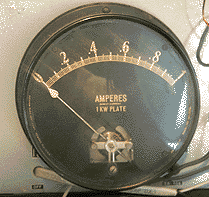
If you want to be Loud, run at least 200 watts of carrier. And, don't forget about the Antenna System. A dipole, up in the air at least 50 feet will work very well under most conditions.
See (or Hear) you on AM
 .
.


